A luxury mechanical watch represents an extraordinary concentration of design, metallurgy, and precision manufacturing. Every surface, tolerance, and point of articulation is developed to create a particular relationship between the case, bracelet, clasp, and wrist.
The strap should be approached with the same level of discipline.
Although rubber watch straps can appear simple, a properly integrated strap is not merely a flexible band cut to the correct width. It must correspond to the three-dimensional architecture of a specific watch case, position the watch correctly on the wrist, accommodate the required attachment hardware and maintain controlled movement without interfering with the case.
Material selection is only the beginning. The finished result depends on geometry, dimensional consistency, flexibility, taper, clasp compatibility, manufacturing quality and correct installation.
This is the engineering behind a vulcanized rubber strap for a luxury watch.
Quick Answer: What Makes an Integrated Rubber Strap Different?
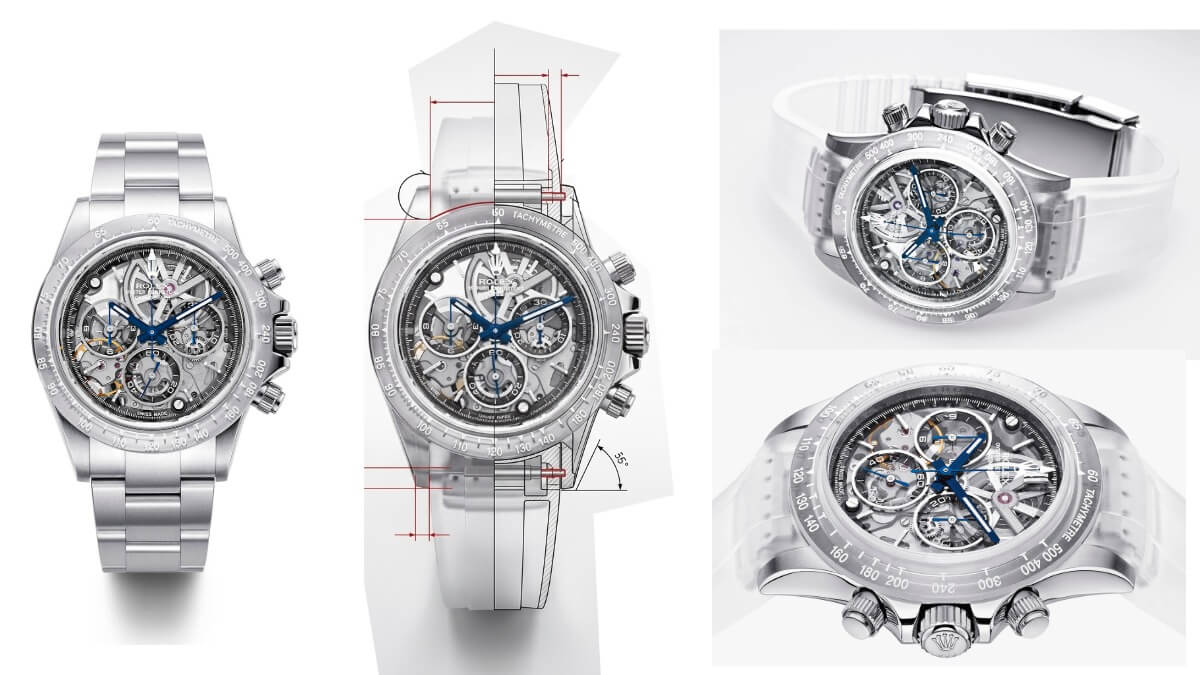
An integrated rubber strap is engineered around the specific case and lug geometry of a compatible watch. Unlike a general-purpose strap selected primarily by lug width, a model-specific strap must account for case curvature, attachment-point position, lug thickness, spring-bar dimensions, strap entry angle, clasp compatibility and wrist articulation.
The objective is not simply to close the visible space between the case and the strap. It is to create a secure and visually continuous interface that behaves as a natural extension of the watch.
Why Strap Engineering Matters
The strap is one of the principal structural connections between a watch and its wearer.
It influences how the watch is secured, how its weight is distributed and how the case sits as the wrist moves. It also contributes significantly to the appearance of the complete timepiece.
A poorly matched strap may technically attach to the watch but still produce an unsatisfactory result. It may leave an excessive gap at the case, position the watch too high, bend at an unsuitable angle or interfere with the intended operation of the clasp.
A carefully engineered strap must address several objectives simultaneously:
- Secure attachment to the compatible watch
- Controlled positioning between the lugs
- Appropriate flexibility around the wrist
- Balanced support for the weight of the case
- Sufficient clearance from the case and bezel
- Compatibility with the intended clasp or buckle
- Dimensional consistency across production
- Resistance to conditions encountered during normal wear
- Visual continuity with the architecture of the watch
These requirements become especially important when working with watches that have distinctive case profiles, integrated-bracelet designs, fixed bars, proprietary clasps or unconventional lug structures.
What Is Vulcanized Rubber?
Rubber begins as an elastomer: a polymeric material capable of deforming under pressure and returning substantially toward its original form.
In its uncured state, rubber may not provide the dimensional stability, strength or durability required for a precisely molded watch strap. Vulcanization transforms the material through a controlled curing process.
During vulcanization, cross-links are created between sections of the polymer chains. These connections restrict the chains from moving independently while preserving the elasticity associated with rubber.
The resulting performance depends on several variables, including:
- The base elastomer
- The curing system
- Cross-link density
- Cure temperature
- Cure duration
- Reinforcing agents
- Stabilizers
- Pigments
- The geometry of the molded component
Vulcanization should therefore not be understood as a single universal formula. Two products described as vulcanized rubber can perform differently depending on their composition, curing process and manufacturing quality.
For a luxury watch strap, the formulation must support both mechanical and sensory requirements. The material must be sufficiently stable to preserve detailed molded geometry while remaining flexible and comfortable against the wrist.
Why Cross-Linking Changes the Material
Polymer chains in uncured rubber can move relative to one another. Cross-linking joins portions of those chains into a network.
This network can improve properties such as:
- Elastic recovery
- Dimensional stability
- Tensile performance
- Resistance to permanent deformation
- Tear performance
- Shape retention
- Durability under repeated flexing
The amount and type of cross-linking must be controlled carefully. Insufficient curing may leave the material unstable or overly soft. Excessive cross-linking may reduce flexibility and produce a harder or more brittle result.
The objective is not maximum hardness. A watch strap requires a carefully balanced structure that can retain its intended form at the case connection while flexing comfortably around the wrist.
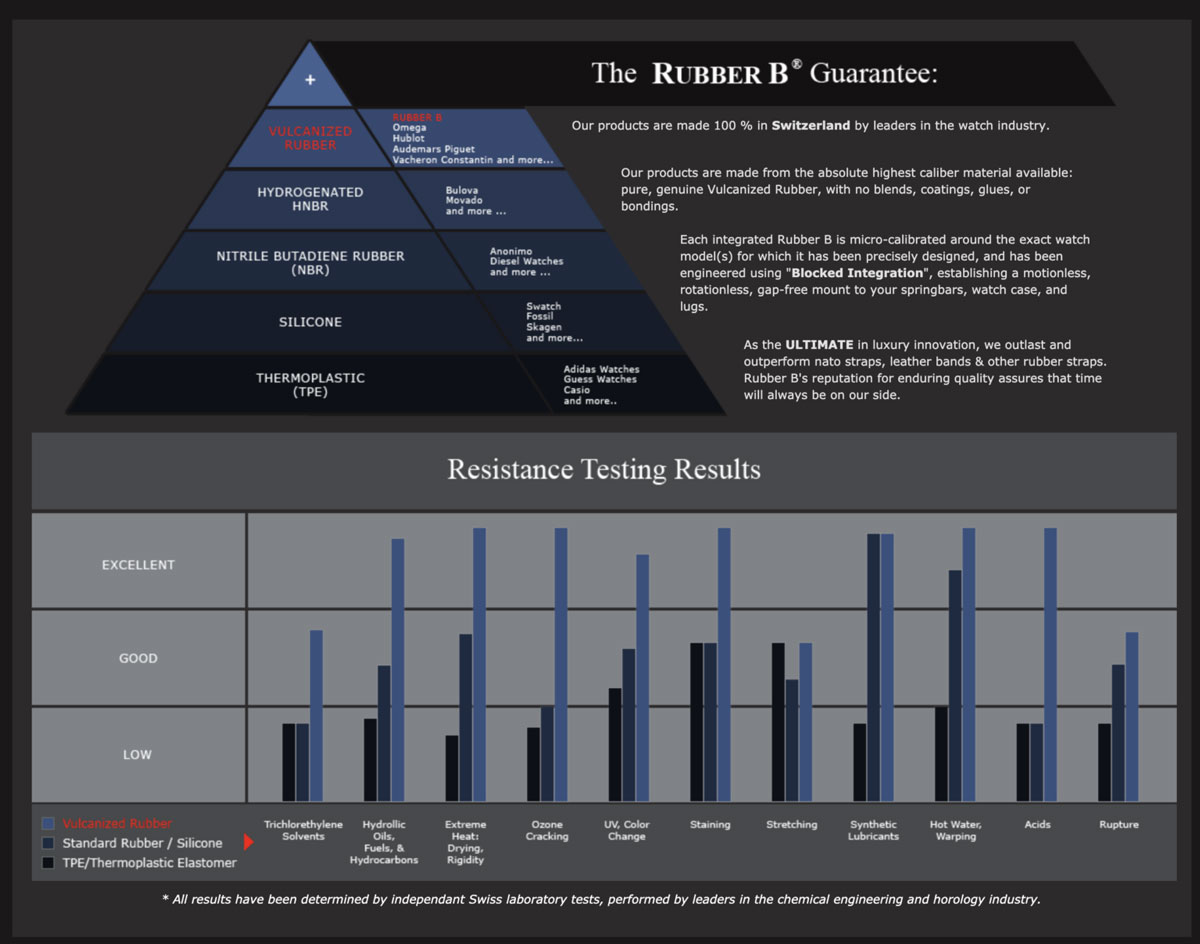
Vulcanized Rubber, Silicone and FKM Compared
The term “rubber strap” is frequently used to describe several materially different products. Vulcanized rubber, silicone and FKM are elastomeric materials, but they are not interchangeable.
Each material category can be formulated in different ways, and quality varies significantly among manufacturers. No material name alone guarantees a superior finished strap.
Vulcanized Rubber
Vulcanized rubber is valued for its ability to combine elasticity with controlled mechanical strength and dimensional stability.
Depending on its formulation and manufacturing process, it can provide:
- Strong shape retention
- A refined, non-gummy surface
- Resistance to tearing
- Controlled flexibility
- Detailed molded geometry
- Consistent positioning at the watch case
- Long-term performance under repeated bending
These characteristics make premium vulcanized rubber well suited to model-specific straps that must retain a precise profile.
Silicone
Silicone is naturally flexible and can remain functional across a broad temperature range. It is also relatively easy to mold into complex shapes.
However, some silicone formulations may:
- Attract dust and lint
- Feel tacky against the skin
- Stretch more readily
- Provide lower tear resistance
- Lack the structural firmness required for certain integrated designs
High-quality silicone can still be appropriate for many applications. Its performance depends on the formulation, hardness, geometry and intended use.
FKM
FKM is a category of fluoroelastomer known for resistance to heat, weathering, oils and many chemicals. It is widely used in demanding industrial sealing applications.
In watch straps, FKM can provide:
- Strong environmental resistance
- A smooth surface
- Good aging characteristics
- Substantial material density
- Resistance to many oils and chemicals
FKM is not automatically more suitable for every watch strap. Depending on its formulation, it may feel denser or firmer than another premium elastomer. The ideal material remains dependent on the strap geometry, desired flexibility and intended wearing conditions.
Material Comparison
| Material | Typical advantages | Possible limitations |
| Vulcanized rubber | Shape retention, tear performance, molded detail and controlled flexibility | Performance depends heavily on formulation and curing quality |
| Silicone | Softness, flexibility, temperature performance and ease of molding | Certain formulations may attract dust, stretch or tear more easily |
| FKM | Resistance to heat, weathering, oils and many chemicals | Can be denser, firmer and more expensive depending on formulation |
The most meaningful question is not simply, “Which material is best?”
The correct question is:
Which material, formulation and construction are appropriate for the specific watch, geometry and intended use?
Lug Width Is Only the First Measurement
A universal watch strap is often selected according to the distance between the lugs. A watch may therefore be described as accepting a 20, 21 or 22 millimeter strap.
That number is important, but it describes only one dimension.
Two watches can share the same nominal lug width while having entirely different case profiles and attachment geometries. A strap that fits between the lugs of one model may not integrate correctly with another.
A model-specific strap must consider the complete three-dimensional structure surrounding the attachment point.
How a Luxury Watch Case Is Measured
Lug Width
Lug width establishes the available space between the inside surfaces of the lugs. It influences the width of the strap at the point of attachment.
For an integrated design, this measurement must be considered together with the curvature and thickness of the case.
Case Curvature
The surface between the lugs may be flat, convex, stepped or interrupted by another component.
The corresponding end of the strap must be shaped to follow that geometry without applying unsuitable pressure against the case. A close visual fit does not mean the strap should be compressed aggressively into the watch.
Controlled clearance remains necessary for installation, articulation and material movement.
Spring-Bar Position
The spring-bar holes are positioned within the lugs according to the architecture of each watch. Their depth, height and distance from the case affect the shape of the strap end.
Even a small difference in spring-bar position can alter:
- The angle at which the strap leaves the case
- The pressure placed on the molded interface
- The amount of visible space below the case
- The range through which the strap can articulate
- Whether the spring bar can seat correctly
Spring-Bar Diameter and Tip Geometry
Spring bars are available in different diameters, lengths, tip sizes and spring tensions.
A compatible strap must provide the appropriate channel or opening for the intended hardware. The spring-bar tips must also correspond correctly to the holes inside the watch lugs.
The fact that a spring bar can be physically inserted does not establish that it is suitable for the watch.
Lug Thickness and Underside Geometry
Luxury watch lugs often contain bevels, recesses, polished surfaces or changes in thickness.
These features affect how the strap end can be installed and how it moves after installation. The underside of the case must also be evaluated to prevent unwanted contact as the strap bends around the wrist.
Case Height
A tall or substantial watch case requires a different support profile from a thin dress watch.
The strap must leave the case at an angle that helps distribute its mass. If the strap drops too sharply, the watch may feel top-heavy. If it remains too rigid, it may create pressure at the edges of the wrist.
Lug-to-Lug Length
Lug-to-lug length influences how the watch spans the wrist. A strap designed for the case must continue that geometry without extending the effective footprint unnecessarily.
This is particularly important for wearers with smaller wrists and for watches with long or angular lugs.
Universal Straps and Model-Specific Straps
A universal strap and a model-specific strap serve different purposes.
Universal Straps
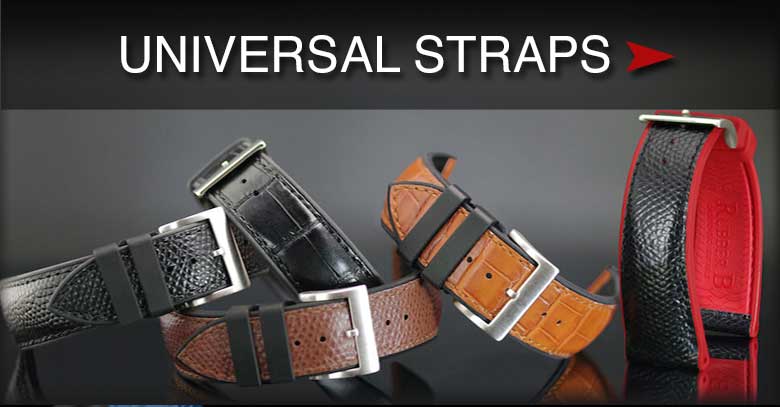
A universal strap is designed to fit a range of watches that share a common lug width.
Its advantages can include:
- Broad compatibility
- Simple sizing
- Easy replacement
- A large variety of materials and colors
- Lower development and manufacturing costs
Many universal straps use a flat end that leaves visible space between the strap and the case. This is not necessarily a defect. It is a consequence of designing for compatibility across multiple watch architectures.
Model-Specific Straps
A model-specific strap is developed around one watch model, case family or clearly defined group of references.
Its geometry may account for:
- The shape of the mid-case
- The position of the spring-bar holes
- The profile of the lugs
- The caseback clearance
- The permitted angle of articulation
- The dimensions of the original clasp
- The visual lines of the watch
The resulting connection can appear more integrated because the strap is shaped around the watch rather than around lug width alone.
However, that specificity also means compatibility must be treated precisely. A strap engineered for one reference should not be assumed to fit another reference merely because both watches have the same case diameter or lug width.
The Mechanics of Blocked Integration™
Rubber B developed Blocked Integration™ to create a calibrated connection between compatible luxury watch cases and Rubber B straps.
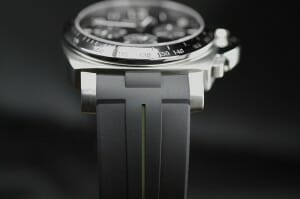
The system is based on model-specific geometry rather than a general flat-end configuration. The strap is designed to position itself against the compatible watch case in a controlled manner, creating a flush and continuous appearance.
The objective is to manage movement at the interface without preventing the strap from articulating naturally around the wrist.
Depending on the supported watch and strap configuration, the engineering may account for:
- Case curvature
- Lug architecture
- Spring-bar position
- Strap-end reinforcement
- Original-clasp compatibility
- The required departure angle from the case
- Side-to-side positioning between the lugs
Blocked Integration™ is a proprietary Rubber B term. It should not be used as a generic description for all curved-end or integrated rubber straps.
Why Movement at the Case Must Be Controlled
A strap cannot be designed as an entirely rigid extension of the watch. It must move as the wrist moves.
The important distinction is between intended articulation and uncontrolled play.
Intended articulation allows the strap to rotate through the range required for installation and wear. Uncontrolled play may permit unnecessary lateral movement or inconsistent positioning between the lugs.
The geometry of a model-specific strap is developed to establish the correct relationship between these two requirements.
A well-designed interface should:
- Allow the spring bar or attachment system to seat correctly
- Maintain suitable clearance from the case
- Minimize unnecessary lateral displacement
- Avoid excessive compression of the rubber
- Permit comfortable wrist articulation
- Preserve the intended visual alignment
The result should feel stable without becoming mechanically restricted.
Engineering the Strap for the Wrist
The case connection is only one part of the design. A strap must also support the watch across a wide variety of wrist shapes and sizes.
Molded Curvature
A pre-curved strap can follow the natural circumference of the wrist more readily than a completely flat component.
The curvature must not be excessive. A strap intended for a range of wrists needs sufficient adaptability to accommodate different circumferences while continuing to support the case.
Flex Zones
Different areas of the strap perform different functions.
The section nearest the case may require greater structural support to maintain the integrated profile. Areas farther from the case generally require greater flexibility to wrap comfortably around the wrist.
These transitions can be controlled through:
- Changes in thickness
- Internal geometry
- Surface channels
- Molded relief
- Taper
- Material distribution
Thickness
A strap that is too thin near a heavy watch case may feel visually and mechanically unbalanced. A strap that remains excessively thick toward the clasp may become rigid or difficult to close.
The thickness profile should therefore change gradually according to the mass of the watch, the intended clasp and the required flexibility.
Taper
Taper describes the reduction in strap width from the watch case toward the clasp or buckle.
It affects:
- Visual proportion
- Wrist comfort
- Clasp compatibility
- Flexibility
- The perceived weight of the watch
The correct taper depends on the design language of the original timepiece. A strong sports watch may require a more substantial profile, while another watch may benefit from a more pronounced reduction in width.
Weight Distribution
A rubber strap does not balance a watch in exactly the same way as a metal bracelet.
The shape and support of the strap should help stabilize the watch head without creating pressure points. Proper sizing also matters. A strap worn too loosely may allow the watch to rotate, while one worn excessively tightly can become uncomfortable as the wrist expands during the day.
Original-Clasp Compatibility
For many collectors, retaining the original watch clasp is an important part of the conversion from a metal bracelet to a rubber strap.
The clasp may contain recognizable design elements, a manufacturer’s signature, a folding safety mechanism or a proprietary adjustment system. Preserving it can maintain part of the watch’s original character.
Engineering a strap for an original clasp is considerably more complex than cutting the strap to the approximate width.
The design must consider:
- Attachment width
- Required strap thickness
- Pin or screw position
- Folding clearance
- Taper
- Strap-tail length
- Clasp blade geometry
- Closure pressure
- Micro-adjustment operation
- Extension-system operation, where applicable
The strap must enter the clasp at the correct angle and thickness. An incorrect profile can prevent the clasp from closing, create excessive friction or interfere with its adjustment system.
Compatibility should always be confirmed according to the exact watch reference, clasp and strap configuration.
Reference-Specific Engineering Across Luxury Watches
Different luxury watches present fundamentally different strap-design challenges.
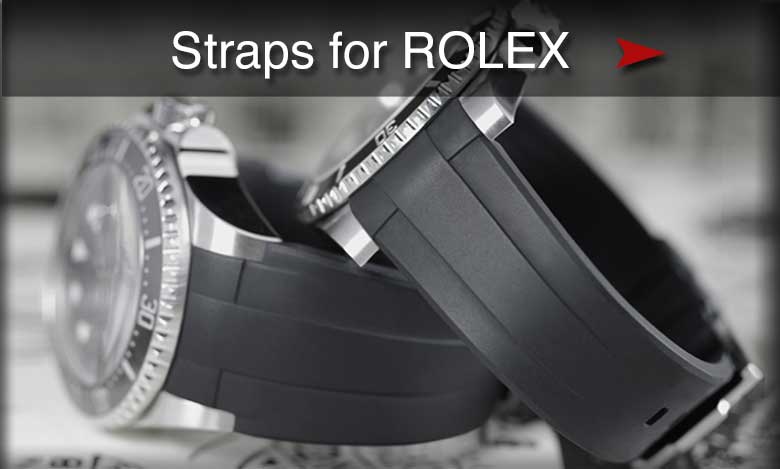
Rolex Submariner
The Rolex Submariner combines a substantial sports-watch case with a recognizable bracelet and clasp architecture.
A model-specific rubber strap may need to account for:
- The geometry of the Oyster case
- The position of the spring-bar holes
- The profile of the lugs
- The transition from the case to the strap
- Compatibility with the original Oysterlock clasp
- Glidelock operation in supported configurations
- Differences between references and case generations
A strap developed for one Submariner generation should not automatically be considered compatible with another.
Rolex Sky-Dweller
The Rolex Sky-Dweller has a larger and more complex case presence than many traditional Rolex models.
Its strap architecture must respond to:
- Case proportions
- Lug geometry
- The height of the watch
- Bracelet or clasp configuration
- Weight distribution
- Supported reference distinctions
These factors influence both the shape of the integrated strap end and the way the watch sits on the wrist.
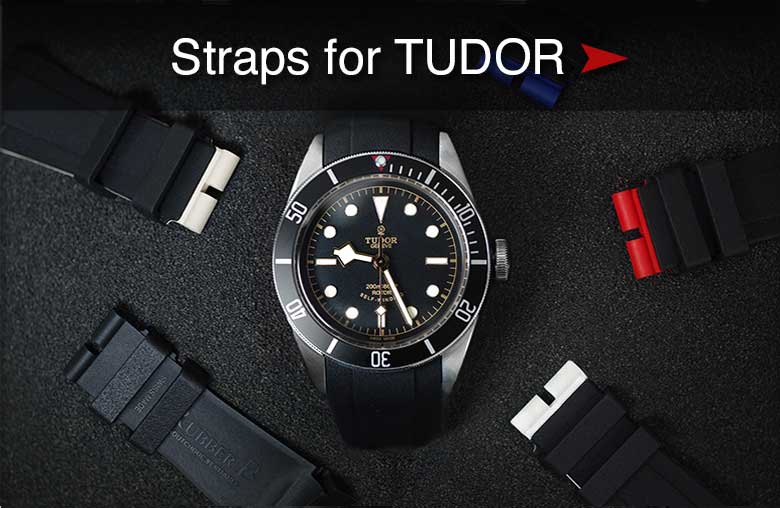
Tudor Pelagos FXD
The Tudor Pelagos FXD requires an entirely different engineering solution because its strap bars are fixed directly into the titanium case.
A conventional closed spring-bar channel cannot be installed in the same manner as it can on a watch with removable spring bars.
Rubber B developed a dedicated Fixed-Bar Interface for the Tudor Pelagos FXD 42mm titanium case. The system incorporates a solid metal insert and a custom spring-bar arrangement to create Blocked Integration™ with the FXD case.
This illustrates an important principle: watches with unconventional attachment systems cannot be addressed simply by modifying the end of a universal strap. The complete attachment method must be reconsidered around the case architecture.
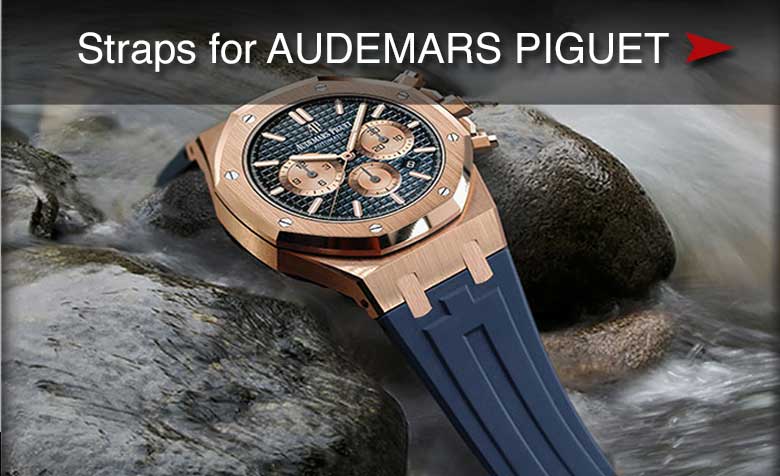
Audemars Piguet Royal Oak
The Audemars Piguet Royal Oak is defined by the relationship between its octagonal case, visible screws and integrated bracelet.
A replacement strap must respect that architectural continuity.
Design considerations may include:
- The angular transition from the case
- The width and visual mass of the lugs
- Attachment hardware
- Case thickness
- Strap taper
- Clasp compatibility
- The need to preserve the geometric character of the watch
Because the bracelet is central to the Royal Oak’s identity, the strap should not appear as an unrelated component attached after the fact.
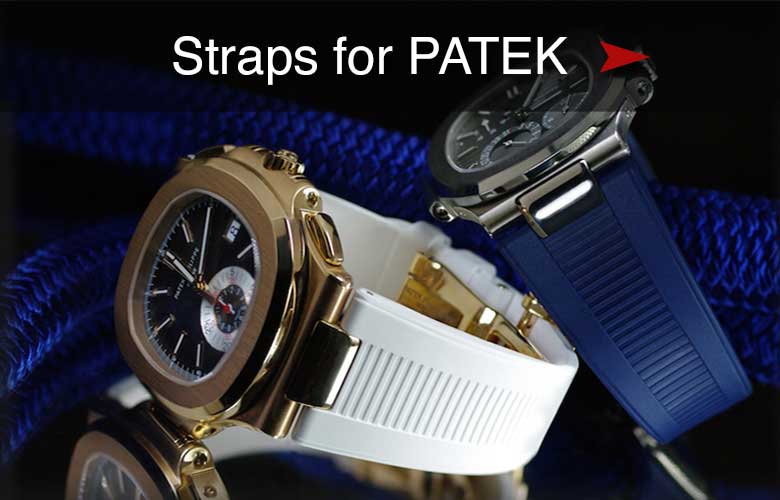
Patek Philippe Aquanaut
The Patek Philippe Aquanaut was designed with a composite-style strap as part of its original visual language.
Its case and strap relationship involves:
- Curved integration
- A distinctive surface pattern
- Reference-specific dimensions
- Folding-clasp compatibility
- Controlled strap thickness
- Precise sizing requirements
Different Aquanaut references may use different cases, clasps and strap dimensions. Compatibility must therefore be established by reference rather than by collection name alone.
Environmental Resistance and Daily Wear
Luxury sports watches are frequently worn in conditions that expose their straps to water, perspiration, ultraviolet light, heat and changing temperatures.
No watch-strap material should be described as indestructible. Environmental performance depends on the elastomer, formulation, pigmentation, curing process and maintenance.
Water and Saltwater
Properly formulated vulcanized rubber is well suited to water-related use because it does not absorb water in the same manner as many natural textile or leather materials.
After saltwater exposure, the watch and strap should be rinsed with fresh water where appropriate. Salt residue can collect around the clasp, spring bars and recessed surfaces even when the rubber itself remains unaffected.
Water resistance of the watch is separate from the water resistance of the strap. The condition and rating of the watch must always be considered independently.
Chlorinated Water
Chlorinated water can leave residue on both the watch and strap. Rinsing after swimming helps remove chemicals and accumulated debris.
Exposure recommendations should always follow the instructions supplied for the particular watch and strap.
Perspiration and Skin Oils
Perspiration contains water, salts and organic compounds. Skin oils, sunscreen, fragrance and cosmetics may also accumulate on the strap.
Routine cleaning helps preserve the surface appearance and prevents residue from collecting in textured areas or near the clasp.
Ultraviolet Exposure
Ultraviolet radiation can contribute to color change and material aging in many polymers.
Rubber formulations may incorporate stabilizing systems intended to improve resistance to ultraviolet exposure and ozone. Performance still depends on the complete material formulation and the duration and intensity of exposure.
Temperature Changes
Elastomers can become firmer or softer as temperatures change. The degree of change depends on the material and formulation.
A luxury watch strap intended for active use should maintain appropriate flexibility under normal wearing conditions. It should not, however, be exposed unnecessarily to extreme heat, open flame or harsh industrial environments.
Installation and Security
Even a correctly engineered strap can perform poorly when installed with incompatible hardware or incorrect technique.
Installation is therefore part of the complete engineering system.
Use the Correct Hardware
The spring bars or attachment components must correspond to the compatible watch and strap.
Important characteristics include:
- Overall length
- Body diameter
- Tip diameter
- Tip shape
- Shoulder design
- Spring tension
- Corrosion resistance
Hardware that appears nearly identical may still differ in a way that affects seating or security.
Protect the Watch Case
Polished steel, gold, platinum, ceramic and titanium surfaces can be marked by tools used incorrectly.
Appropriate precautions may include:
- Working on a stable, protected surface
- Using properly sized tools
- Applying removable protective material near the lugs
- Approaching the spring bar from the correct direction
- Avoiding excessive force
- Having installation completed by an experienced watchmaker when necessary
Confirm That the Attachment Is Seated
After installation, both ends of the spring bar or attachment system must be fully engaged.
The strap should be examined from several angles. Gentle, controlled pressure can help verify that the attachment is seated, but aggressive pulling should be avoided.
If the strap appears misaligned, unusually compressed or difficult to articulate, it should be removed and inspected rather than forced into position.
Inspect the Strap Periodically
Spring bars, screws, inserts and straps are wear components.
Periodic inspection is particularly important after:
- Impact
- Heavy activity
- Frequent saltwater exposure
- A strap change
- Clasp adjustment
- Extended use
Any damaged, bent or corroded attachment component should be replaced with an appropriate compatible part.
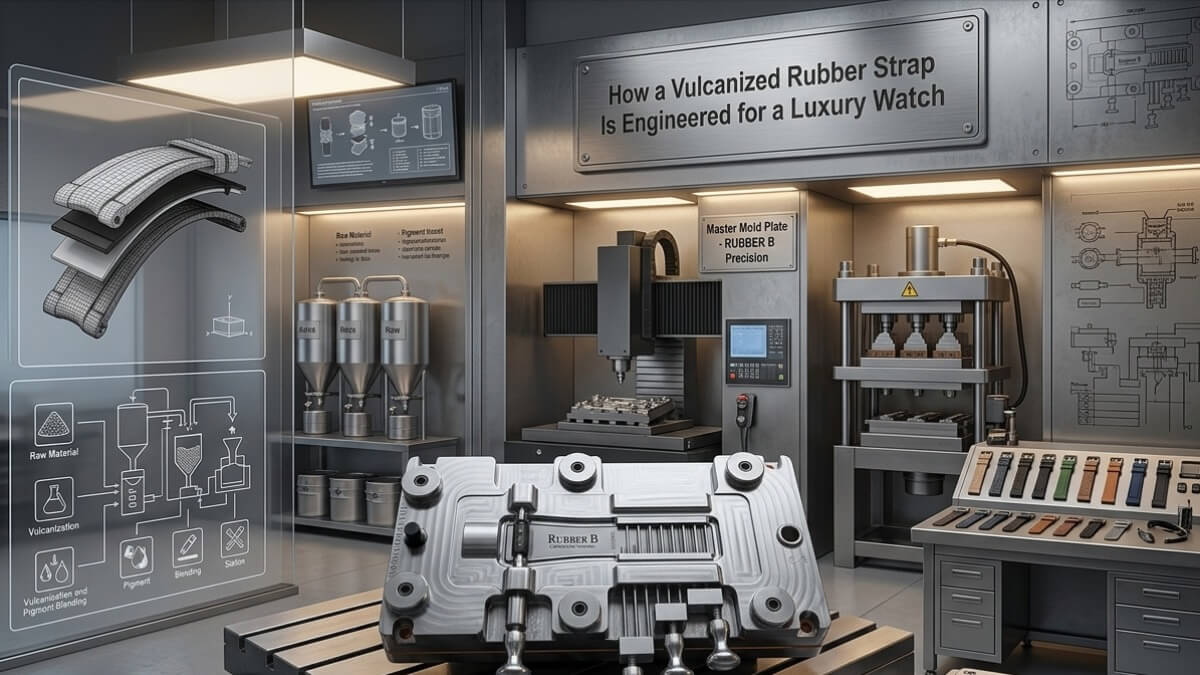
From Digital Model to Finished Strap
An integrated strap requires a development process that connects watch-case analysis with material manufacturing.
Although the exact methods differ among manufacturers and products, the process commonly includes several major stages.
1. Compatibility Definition
The development process begins by defining the exact watch reference, case material, case generation and clasp configuration to be supported.
This step prevents compatibility from being reduced to a broad model name.
2. Dimensional Analysis
The relevant case and attachment geometry is measured.
This may include:
- Lug width
- Lug thickness
- Spring-bar position
- Case curvature
- Caseback clearance
- Attachment-hardware dimensions
- Clasp dimensions
- Strap departure angle
3. Digital Development
The measurements are translated into a three-dimensional model.
Digital modeling allows the strap end, internal channels, thickness transitions and clasp connection to be evaluated before production tooling is completed.
4. Prototype Evaluation
Prototypes are installed on the intended watch and examined for:
- Fit
- Clearance
- Articulation
- Alignment
- Case contact
- Hardware seating
- Clasp operation
- Wrist comfort
- Visual proportion
A successful digital model does not eliminate the need for physical evaluation. Elastomer behavior must be observed in the finished geometry.
5. Tooling and Molding
Once the design is approved, production tooling is prepared.
The mold must reproduce both the visible surfaces and the functional geometry of the strap. This includes attachment channels, relief structures, edges, texture, taper and any internal reinforcement required by the design.
6. Curing
The rubber compound is formed and cured according to a controlled process.
Cure conditions influence the completed material. Temperature, pressure and time must be managed to achieve the intended shape and mechanical properties.
7. Finishing
After molding, the strap may require trimming, cleaning and detailed finishing.
Edges, molded surfaces, holes and attachment points must be examined for irregularities that could affect comfort, appearance or installation.
8. Dimensional Quality Control
Finished components must be checked against the approved design.
Relevant points may include:
- Width
- Thickness
- Attachment geometry
- Clasp interface
- Hole position
- Surface quality
- Alignment
- Symmetry
Because rubber is elastic, inspection methods must account for the difference between a relaxed component and one placed under tension.
9. Compatibility Validation
The completed strap is validated on the intended watch and clasp configuration.
This is the final confirmation that a component matching its dimensional specification also functions correctly as part of the assembled system.
The Importance of Swiss Manufacturing
Switzerland’s watchmaking reputation is built not only on mechanical movements but also on a wider network of specialized manufacturing, tooling, finishing and quality-control disciplines.
Rubber B straps are handcrafted and finished in Switzerland. They are calibrated to fit specific compatible luxury watches and clasp configurations.
Swiss manufacturing is meaningful when it is expressed through the finished product:
- Controlled material preparation
- Accurate tooling
- Consistent molding
- Clean finishing
- Model-specific validation
- Repeatable production quality
Country of origin alone does not replace engineering. It identifies the manufacturing context in which the product is developed and completed.
A Strap Is Part of the Watch-Wearing System
An integrated vulcanized rubber strap is not simply an alternative color or material.
It becomes part of a complete system involving:
- The watch case
- The lugs or fixed bars
- The attachment hardware
- The strap body
- The clasp
- The wearer’s wrist
Each component influences the others.
A secure spring bar cannot compensate for incorrect strap geometry. A precisely molded strap cannot compensate for incompatible hardware. A properly engineered clasp connection cannot compensate for incorrect sizing.
The complete result depends on every interface functioning as intended.
Frequently Asked Questions
What makes a rubber watch strap integrated?
An integrated rubber strap is shaped around the case and lug architecture of a particular watch or reference family. Its molded end is intended to create a controlled visual and mechanical transition between the case and strap.
Is vulcanized rubber better than silicone?
What makes a rubber watch strap integrated?
An integrated rubber strap is shaped around the case and lug architecture of a particular watch or reference family. Its molded end is intended to create a controlled visual and mechanical transition between the case and strap.
Is FKM the same as vulcanized rubber?
FKM is a specific category of fluoroelastomer. FKM components are normally cured or vulcanized during manufacture, but not every vulcanized rubber product is made from FKM. “Vulcanized” describes a curing process, while FKM identifies an elastomer family.
Why is lug width not enough to select an integrated strap?
Lug width measures only the distance between the lugs. An integrated strap must also account for case curvature, spring-bar position, lug thickness, caseback clearance and the angle at which the strap leaves the watch.
Can one integrated strap fit several watch references?
Sometimes, but only when those references share the relevant case, lug, hardware and clasp geometry. Compatibility should be confirmed using the exact reference rather than inferred from case diameter or model name.
Can an integrated strap use the original watch clasp?
Certain straps are engineered for the original clasp. The strap must match the clasp’s attachment width, thickness, folding clearance and adjustment geometry. Original-clasp compatibility should be confirmed for the specific watch and strap.
Can the wrong spring bar damage a watch?
An incompatible spring bar may fail to seat correctly, create unnecessary movement or place unsuitable pressure on the attachment interface. Correct dimensions and tip geometry are essential for secure installation.
Does vulcanized rubber attract dust?
Premium vulcanized rubber can have a dry, refined surface that attracts less visible dust than certain tackier silicone formulations. Surface behavior still depends on the specific compound, texture and finish.
Can a vulcanized rubber strap be worn in saltwater?
A strap designed for aquatic use may be worn in saltwater when compatible with the watch and manufacturer instructions. The watch and strap should be rinsed with fresh water afterward to remove salt residue from the clasp and attachment areas.
How should a vulcanized rubber strap be cleaned?
The strap can generally be cleaned using fresh water and a mild soap, followed by careful rinsing and drying. Abrasive cleaners, aggressive solvents and harsh chemicals should be avoided.
How often should spring bars be inspected?
Spring bars should be examined periodically and after a significant impact, strap replacement or prolonged exposure to demanding conditions. Bent, corroded or damaged hardware should be replaced with appropriate compatible components.
Is an integrated strap more secure than a universal strap?
Security depends on the complete system, including strap construction, compatible hardware and correct installation. A model-specific strap can provide more controlled positioning at the case, but integration alone should not be interpreted as a guarantee against attachment failure.
Precision Beyond the Movement
Luxury watch engineering does not end at the edge of the case.
A properly developed vulcanized rubber strap must respond to the same principles that define the watch itself: material selection, dimensional control, functional geometry and manufacturing consistency.
The difference between a universal strap and a case-specific integrated strap is therefore more than visual. It is the difference between designing around a common width and designing around an entire three-dimensional architecture.
When the material, attachment interface, strap profile and clasp connection are developed as a unified system, the strap becomes a complementary piece of precision engineering—one designed to respect the identity, proportions and intended performance of the timepiece.
Rubber B manufactures Swiss-Made vulcanized rubber straps calibrated for compatible models from Rolex, Tudor, Audemars Piguet, Patek Philippe and other leading luxury watchmakers.
The First. The Only. The Ultimate.
Rubber B is an independent company and is not affiliated with, authorized by, sponsored by or otherwise associated with Rolex SA, Tudorwatch SA, Audemars Piguet, Patek Philippe SA or any other watch manufacturer referenced in this article. All trademarks are the property of their respective owners.
Follow Us on Instagram