What Are the Different Types of Rolex Bracelets?
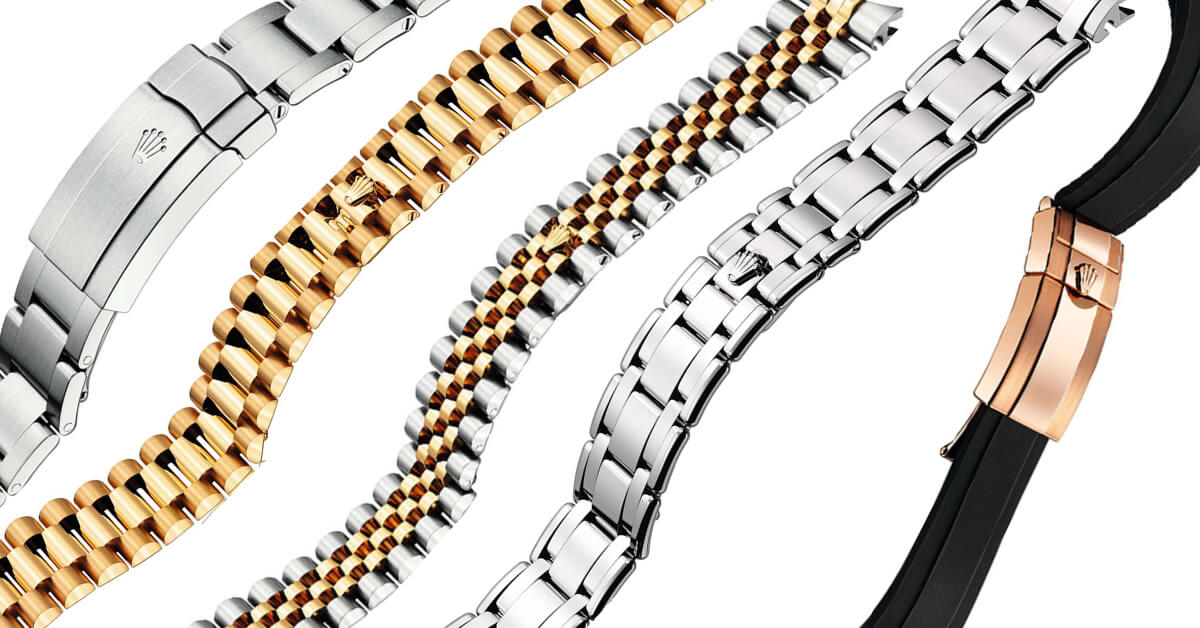
Rolex bracelets are integral to the design, comfort and identity of the watches they accompany. The principal Rolex bracelet types include the three-link Oyster, five-link Jubilee, semi-circular President, elastomer-covered Oysterflex, integrated Flat Jubilee and seven-link Settimo. Collectors may also encounter the historic Pearlmaster bracelet on earlier precious-metal Rolex watches.
Each of these Rolex bracelets has its own construction, visual character and intended application. Some were developed for professional watches, while others were created specifically for elegant models such as the Datejust, Day-Date, Land-Dweller and Perpetual 1908
Rolex Bracelet Types at a Glance
| Rolex bracelet | Construction | Character | Closely associated models |
| Oyster | Broad, flat three-piece links | Robust and versatile | Submariner, Daytona, GMT-Master II, Explorer, Oyster Perpetual |
| Jubilee | Supple five-piece links | Refined and comfortable | Datejust, Lady-Datejust, selected GMT-Master II models |
| President | Semi-circular three-piece links | Formal and prestigious | Day-Date |
| Oysterflex | Metal blades overmoulded with elastomer | Sporty and technical | Yacht-Master, selected Daytona and Sky-Dweller models |
| Flat Jubilee | Flat five-piece integrated links | Contemporary and architectural | Land-Dweller |
| Settimo | Rows of seven small links | Lightweight and jewellery-inspired | Perpetual 1908 |
| Pearlmaster | Rounded precious-metal links | Jewellery-oriented | Historic Pearlmaster models |
Why the Rolex Bracelet Matters
A Rolex bracelet is not simply an attachment used to hold a watch on the wrist. Its proportions, articulation, finishing and clasp system influence the appearance and wearing experience of the complete timepiece.
The broad links of an Oyster bracelet reinforce the functional character of a Submariner or Explorer. The smaller links of a Jubilee create greater visual detail and flexibility. The President bracelet contributes to the formal identity of the Day-Date, while Oysterflex introduces a technical alternative to a conventional metal bracelet.
Rolex also develops different clasp and extension systems according to the intended use of each watch. Depending on the model, these can include the Oysterclasp, Oysterlock safety clasp, Crownclasp, Easylink comfort extension and Rolex Glidelock extension system.
Not every Oyster bracelet uses Glidelock, and not every Jubilee bracelet uses the same clasp. The precise configuration of Rolex bracelets depends on the model and reference.
The Rolex Oyster Bracelet
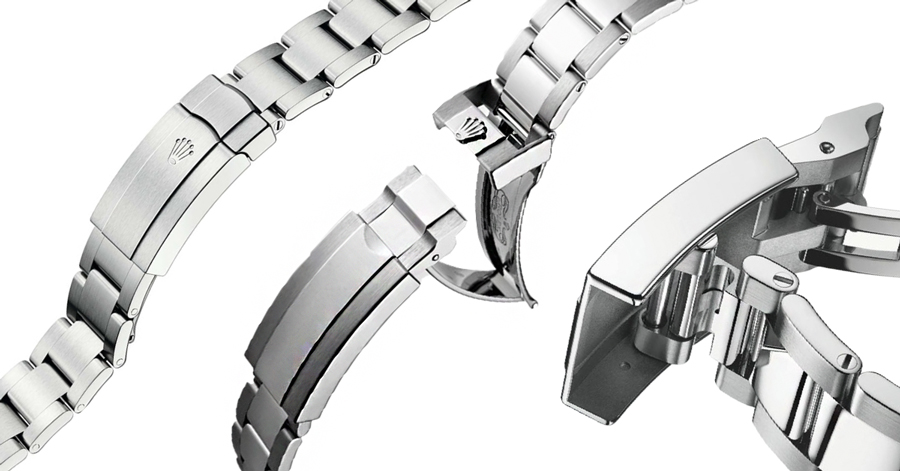
The Oyster bracelet is the most widely recognized and versatile of all Rolex bracelets. Rolex traces the familiar broad, flat three-piece link design to the late 1930s. Its straightforward architecture combines strength, comfort and a distinctly functional appearance.
The bracelet consists of one central link positioned between two outer links. Compared with the more intricate Jubilee bracelet, its larger surfaces create a cleaner and more substantial visual profile.
Which Rolex Watches Use the Oyster Bracelet?
The Oyster bracelet has appeared across a broad range of Rolex watches, including:
- Rolex Submariner
- Rolex Sea-Dweller
- Rolex Deepsea
- Rolex GMT-Master II
- Rolex Cosmograph Daytona
- Rolex Explorer
- Rolex Explorer II
- Rolex Air-King
- Rolex Oyster Perpetual
- Rolex Datejust
- Rolex Sky-Dweller
- Rolex Yacht-Master
Its exact construction, metal, finish and clasp can vary substantially between collections.
A brushed Oyster bracelet on a professional watch has a more utilitarian character, while polished center links can create a more formal appearance on models such as certain Daytona, GMT-Master II and Datejust references.
Oysterclasp, Oysterlock and Glidelock
These three terms are often confused, but they describe different components rather than interchangeable versions of the same clasp.
The Oysterclasp is a folding clasp used across several Rolex collections.
The Oysterlock is a folding safety clasp designed to help prevent accidental opening. It is frequently associated with professional watches.
The Easylink comfort extension allows the wearer to increase bracelet length by approximately 5 mm on compatible models.
The Rolex Glidelock extension system provides a broader range of tool-free adjustment. It is found on selected professional models and is particularly useful when accommodating changing wrist conditions or, on diving watches, wearing the watch over equipment.
The bracelet and clasp combination must therefore be evaluated according to the exact Rolex model rather than the bracelet name alone.
The Rolex Jubilee Bracelet
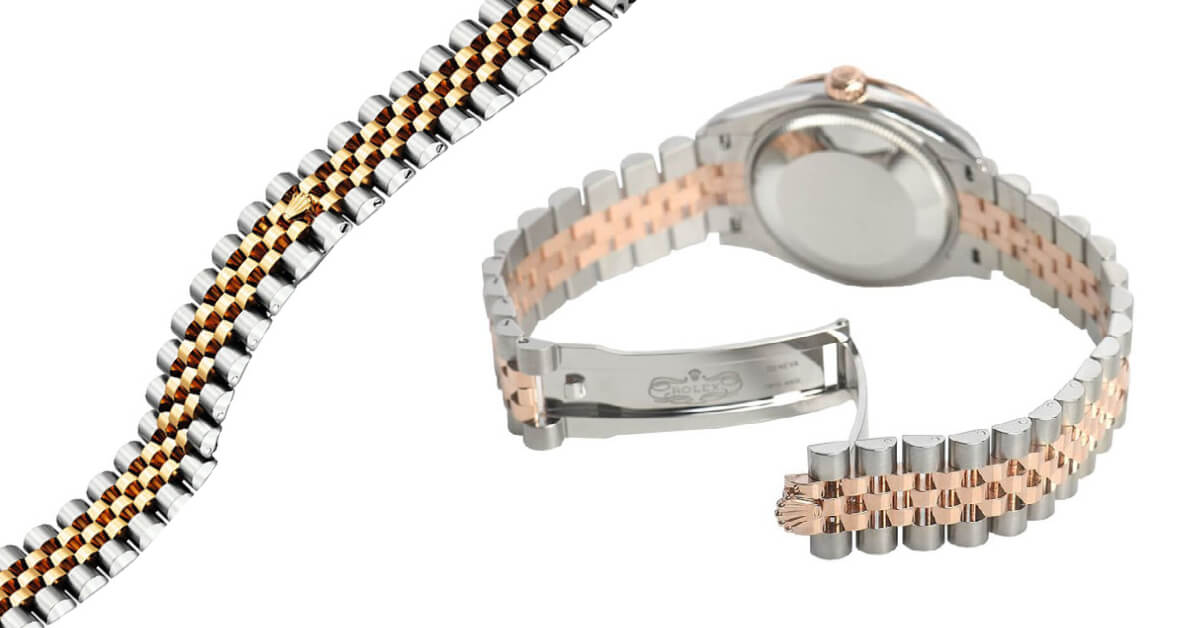
The Jubilee bracelet was created for the launch of the Rolex Datejust in 1945. Its five-piece link structure remains one of the most distinctive designs among Rolex bracelets.
It is composed of three narrower center links positioned between two broader outer links. The smaller articulated elements allow the bracelet to conform closely to the wrist, contributing to its reputation for comfort and flexibility.
Which Rolex Watches Use the Jubilee Bracelet?
The Jubilee is most closely associated with:
- Rolex Datejust
- Rolex Lady-Datejust
- Selected Rolex GMT-Master II references
The bracelet was developed specifically for the Datejust, but its use on modern GMT-Master II references demonstrates that Rolex does not reserve it exclusively for traditional dress watches.
On certain GMT-Master II models, the Jubilee bracelet is paired with an Oysterlock folding safety clasp and an Easylink comfort extension. On the Lady-Datejust, Rolex also offers Jubilee configurations with the concealed Crownclasp.
Is the Jubilee More Comfortable Than the Oyster?
Comfort is subjective, but the Jubilee’s smaller links generally allow it to articulate more freely around the wrist. The Oyster bracelet feels broader and more substantial, while the Jubilee often feels softer and more flexible.
The better choice depends on the intended appearance:
- Oyster for a cleaner and more sporting profile
- Jubilee for greater visual detail and flexibility
- President for a more formal precious-metal presentation
The Rolex President Bracelet
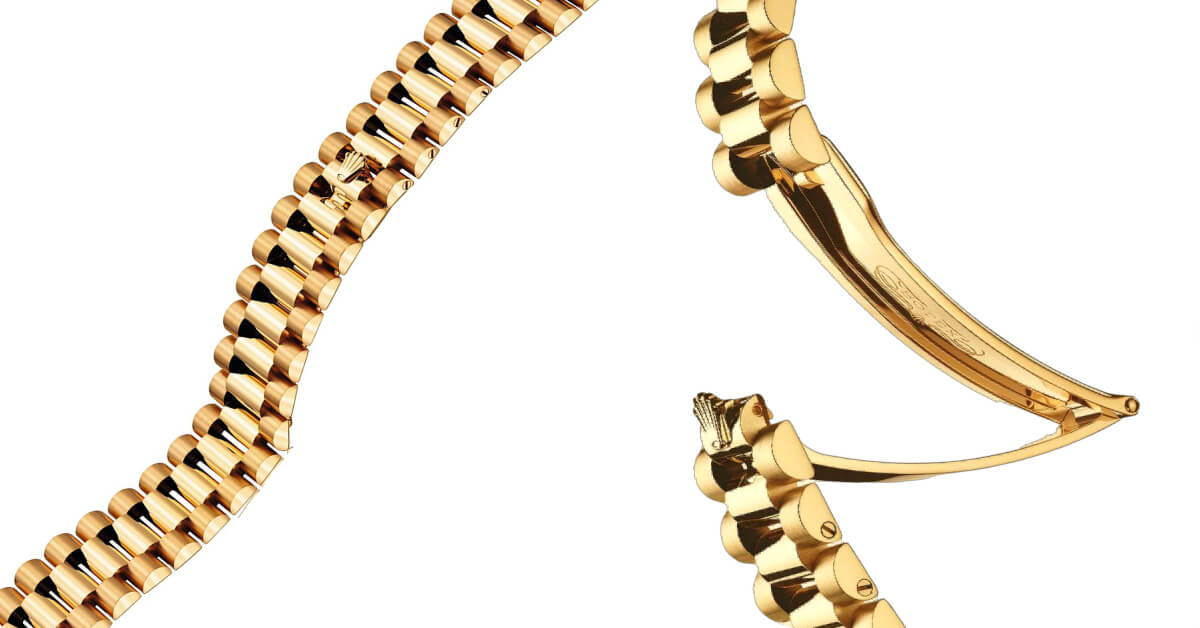
The President bracelet was introduced in 1956 with the Rolex Day-Date. It uses semi-circular three-piece links and is manufactured exclusively in 18 ct gold or 950 platinum.
Its construction can be viewed as more rounded and formal than that of the Oyster bracelet. The links create a continuous sequence of polished curves, giving the bracelet a softer and more jewellery-oriented appearance without adopting the smaller five-link format of the Jubilee.
Which Rolex Watches Use the President Bracelet?
The President bracelet is inseparable from the identity of the Rolex Day-Date. Rolex states that the current Day-Date is always paired with its iconic President bracelet. The Day-Date is offered exclusively in precious metals and is currently available in 36 mm and 40 mm sizes.
The term “President” is sometimes used informally to describe similar bracelet designs, but within Rolex terminology it refers to this specific semi-circular three-piece bracelet — one of the more exclusive Rolex bracelets, since it is never produced in steel.
The Rolex Oysterflex Bracelet
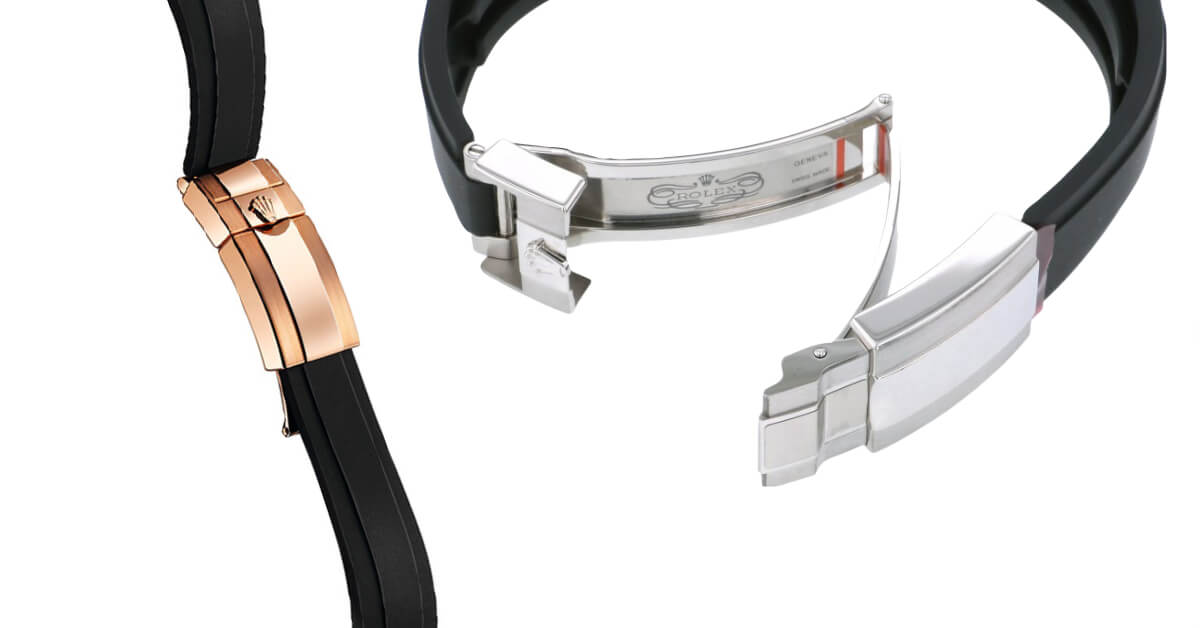
Rolex introduced the Oysterflex bracelet in 2015 on the Yacht-Master 37. Although it has the outward appearance of a rubber strap, Rolex classifies it as a bracelet because its construction contains flexible metal blades overmoulded with high-performance black elastomer.
This distinction is important. Oysterflex is not a solid piece of conventional rubber. Each bracelet section contains a curved metal blade made from a titanium and nickel alloy, providing structural strength beneath the elastomer exterior.
Cushions on the inner surface help stabilize the watch and improve airflow between the bracelet and the wrist. Depending on the model, Oysterflex may be paired with an Oysterlock safety clasp or an Oysterclasp and can include the Rolex Glidelock extension system.
Which Rolex Watches Use Oysterflex?
Oysterflex is available on selected precious-metal versions of:
- Rolex Yacht-Master
- Rolex Cosmograph Daytona
- Rolex Sky-Dweller
The bracelet is offered in black and creates a more technical, sporting profile than a full precious-metal bracelet.
Is Oysterflex a Rubber Strap?
Oysterflex uses a high-performance elastomer exterior, but its internal metal-blade construction differentiates it from a conventional solid rubber watch strap.
Both can provide a sporting alternative to a metal bracelet, but they should not be treated as identical products.
The Rolex Flat Jubilee Bracelet
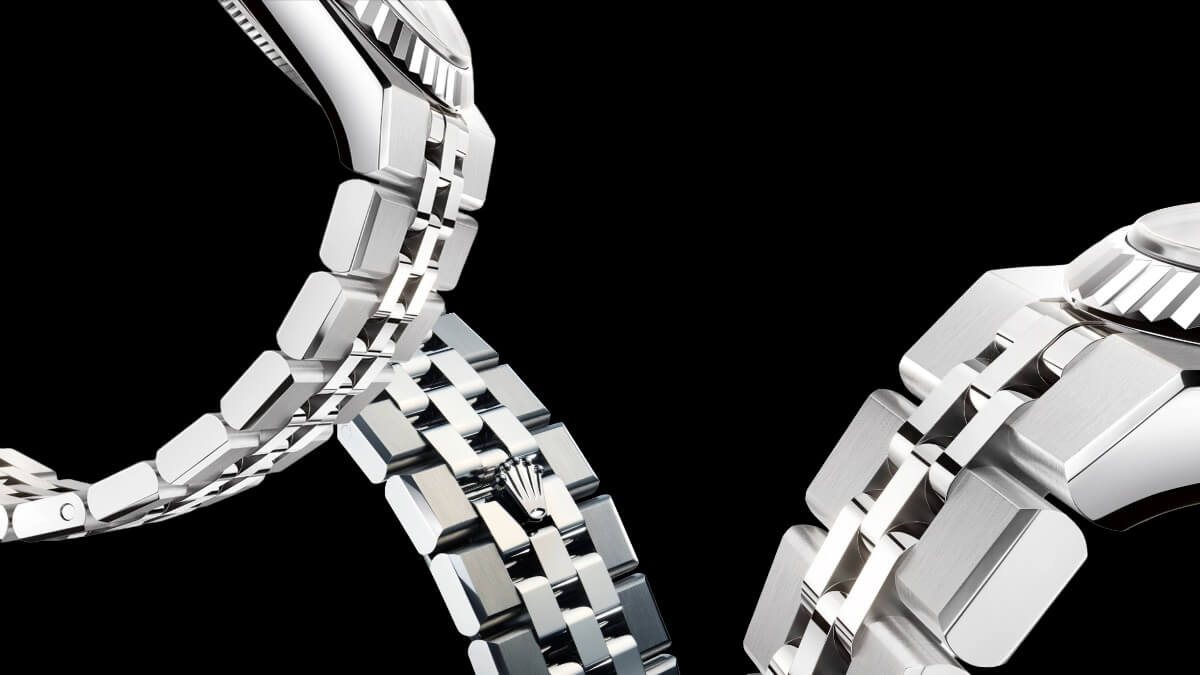
The Flat Jubilee bracelet was introduced in 2025 with the Rolex Land-Dweller. It reinterprets the traditional Jubilee bracelet through a flatter, fully integrated construction designed specifically for the new case.
Like the traditional Jubilee, it retains a five-piece structure with three narrower center links between two broader outer links. The principal difference is that all the links are flat.
The bracelet’s outer links feature technical satin finishing and polished chamfered edges. Its center links are slightly raised and polished, creating visual continuity between the bracelet and the redesigned Oyster case.
A concealed Crownclasp preserves the uninterrupted integrated appearance. Rolex also developed a dedicated attachment system with ceramic inserts around the spring bar to help reduce premature wear.
Which Rolex Watch Uses the Flat Jubilee?
The Flat Jubilee is exclusive to the Rolex Land-Dweller, available in 36 mm and 40 mm versions.
It represents a major development in Rolex bracelet architecture because the bracelet and case were conceived as a unified integrated design rather than as visually separate components.
The Rolex Settimo Bracelet
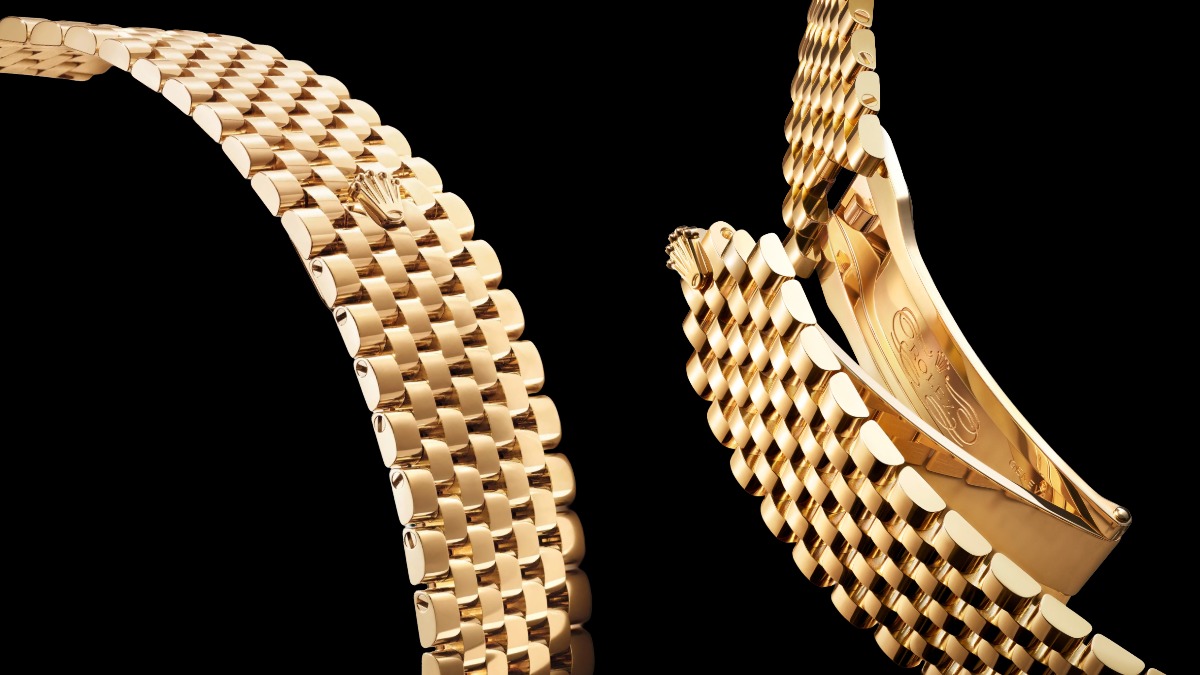
Rolex introduced the Settimo bracelet in 2025 for the Perpetual 1908. Its name refers to its seven-link structure: five narrower center links flanked by two broader outer links, echoing the Jubilee’s proportions in a smaller, more compact format. The links are rounded, polished and carefully contoured to create a light, flexible and jewellery-inspired appearance.
The Settimo is crafted from 18 ct yellow gold and is equipped with a concealed Crownclasp. A dedicated attachment system connects it to the case of the Perpetual 1908.
Which Rolex Watch Uses the Settimo Bracelet?
The Settimo bracelet is reserved for the Rolex Perpetual 1908.
Its seven-piece construction distinguishes it from:
- The three-piece Oyster
- The five-piece Jubilee
- The three-piece President
- The five-piece Flat Jubilee
The bracelet draws inspiration from the refined, jewellery-like bracelets found on certain historic watches while remaining recognizably modern in its finishing and integration.
The Rolex Pearlmaster Bracelet

The Historic Rolex Pearlmaster Bracelet
The Pearlmaster bracelet is associated with the Rolex Pearlmaster collection introduced in the 1990s. Its rounded links and concealed Crownclasp gave it a jewellery-oriented character that complemented the precious-metal cases, gem-set bezels and diamond configurations frequently found within the collection.
Unlike the Oyster, Jubilee and President bracelets, the Pearlmaster was not widely distributed across the broader Rolex catalog. It remained closely tied to the Pearlmaster family, contributing to its comparative rarity.
The Pearlmaster bracelet belongs principally to Rolex’s historical catalog rather than the primary bracelet families emphasized across the current collection.
Rolex Bracelet Comparison: Oyster vs. Jubilee vs. President
The Oyster, Jubilee and President remain the three best-known traditional Rolex bracelets, but each serves a different aesthetic purpose.
Oyster Bracelet
Best suited to collectors seeking:
- A clean three-link design
- A robust sporting appearance
- Broad model availability
- A balance between professional and formal use
Jubilee Bracelet
Best suited to collectors seeking:
- A more flexible five-link design
- Greater surface detail
- A classic Datejust identity
- A balance between elegance and everyday wear
President Bracelet
Best suited to collectors seeking:
- Precious-metal construction
- A formal and prestigious appearance
- Semi-circular three-piece links
- The defining bracelet of the Rolex Day-Date
There is no single bracelet that is objectively superior. The choice among these Rolex bracelets depends on the model, wrist preference, intended use, and desired visual character.
Which Rolex Bracelet Is the Most Comfortable?
The Jubilee is frequently regarded as one of the most comfortable traditional Rolex bracelets because its smaller links articulate closely around the wrist.
However, comfort also depends on:
- Correct bracelet sizing
- Clasp position
- Wrist shape
- Watch weight
- Extension-system adjustment
- Personal preference
The President and Settimo bracelets also offer highly articulated constructions, while Oysterflex uses interior cushions and flexible elastomer to stabilize the watch.
Which Rolex Bracelet Is the Most Durable?
The Oyster bracelet is generally considered the most function-oriented traditional design because of its broad, robust three-piece links and extensive use across Rolex professional watches.
Durability cannot be judged by bracelet family alone. The age of the bracelet, condition of the links, pin wear, clasp condition, maintenance history and fit all affect the long-term performance of any Rolex bracelet.
A loose or damaged bracelet should be inspected by a qualified watch professional.
Can a Rolex Bracelet Be Replaced With a Rubber Strap?
Selected Rolex watches can be fitted with an aftermarket rubber strap, but compatibility depends on the exact case reference, lug geometry and clasp configuration.
A properly engineered rubber strap should be designed for the specific Rolex model rather than treated as a universal accessory. Important considerations include:
- Exact watch reference
- Case diameter
- Lug shape
- Spring-bar position
- Original clasp compatibility
- Clearance between the case and strap
- Intended integration with the watch
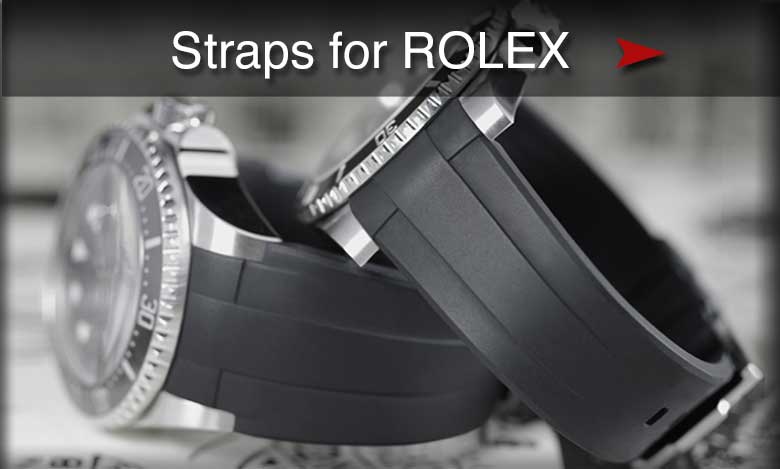
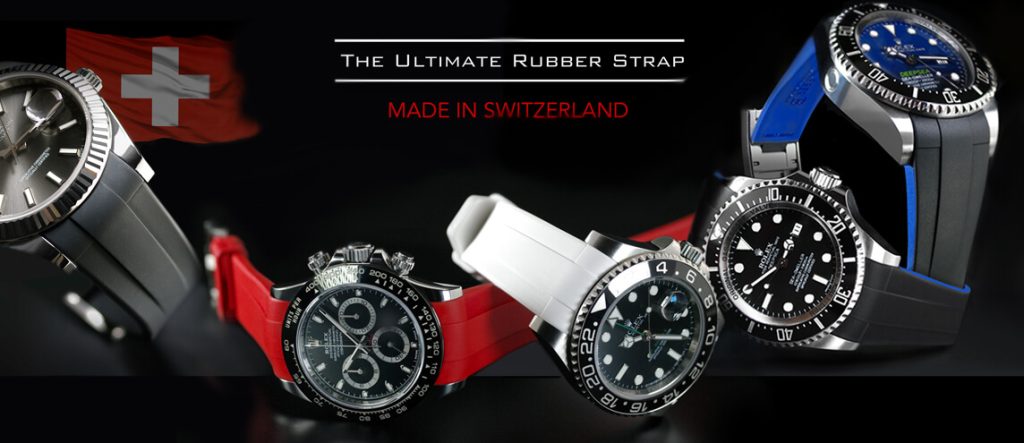
Rubber B develops Swiss-Made vulcanized rubber straps engineered for precise compatibility with selected Rolex references. Depending on the product, the strap may be designed to integrate with the original Rolex clasp or with a dedicated buckle system.
Choosing Between a Rolex Bracelet and a Rubber Strap
A Rolex metal bracelet preserves the original factory configuration and established visual identity of the watch. A model-specific rubber strap offers a different wearing experience suited to sport, travel, water exposure and warm climates.
The decision does not need to be permanent. Many owners retain the original bracelet and alternate it with a compatible rubber strap according to the environment or intended style.
A Rolex Submariner on an Oyster bracelet maintains its classic professional configuration. The same watch on a precisely fitted vulcanized rubber strap adopts a more contemporary and sport-oriented profile while retaining the original bracelet for future use.
Frequently Asked Questions About Rolex Bracelets
What are the main types of Rolex bracelets?
The principal Rolex bracelet families are Oyster, Jubilee, President, Oysterflex, Flat Jubilee, and Settimo. The Pearlmaster bracelet is also found within Rolex’s historical catalog.
What is the most common Rolex bracelet?
The Oyster is the most widely used Rolex bracelet. Its broad three-piece link design appears across professional, classic, and everyday Rolex collections.
What is the difference between Oyster and Jubilee bracelets?
The Oyster uses three broad, flat links and generally has a more robust appearance. The Jubilee uses five smaller links, creating greater articulation and a more detailed, refined appearance.
What is the difference between Jubilee and President bracelets?
The Jubilee uses five-piece links and is closely associated with the Datejust. The President uses semi-circular three-piece links, is made exclusively from precious metals and is closely associated with the Day-Date.
Is Oysterflex made from rubber?
Oysterflex uses a high-performance elastomer exterior, but each side contains a flexible metal blade. It is therefore more structurally complex than a conventional solid rubber strap.
What is the newest Rolex bracelet?
The Flat Jubilee and Settimo bracelets were both introduced in 2025. The Flat Jubilee was developed for the Land-Dweller, while the Settimo was created for the Perpetual 1908.
Does every Rolex bracelet use the same clasp?
No. Rolex uses several clasp and extension configurations, including Oysterclasp, Oysterlock, Crownclasp, Easylink, and Glidelock. The configuration depends on the model and bracelet.
Can a rubber strap use the original Rolex clasp?
Some model-specific rubber straps are engineered to integrate with the original Rolex clasp. Compatibility must be confirmed according to the exact watch reference and strap design.
The Continuing Evolution of Rolex Bracelets
Rolex bracelet design has continued to evolve alongside the watches themselves. The Oyster established a functional three-link architecture. The Jubilee introduced a more supple five-link construction. The President became inseparable from the prestige of the Day-Date, while Oysterflex combined an internal metal structure with a high-performance elastomer exterior.
More recent developments demonstrate that innovation across Rolex bracelets remains active. The Flat Jubilee creates an integrated architecture for the Land-Dweller, while the Settimo introduces a seven-link precious-metal design for the Perpetual 1908.
Together, these Rolex bracelets show how construction, comfort and visual identity contribute to the character of a Rolex watch.
For owners seeking an alternative configuration, Rubber B manufactures Swiss-Made vulcanized rubber straps developed for selected Rolex models and references. Each compatible design is created to respect the dimensions and architecture of the intended watch while providing a distinctly technical wearing experience.
Rubber B is an independent company and is not affiliated with, authorized by, or endorsed by Rolex SA.
For more information, you can always go to rolex.com