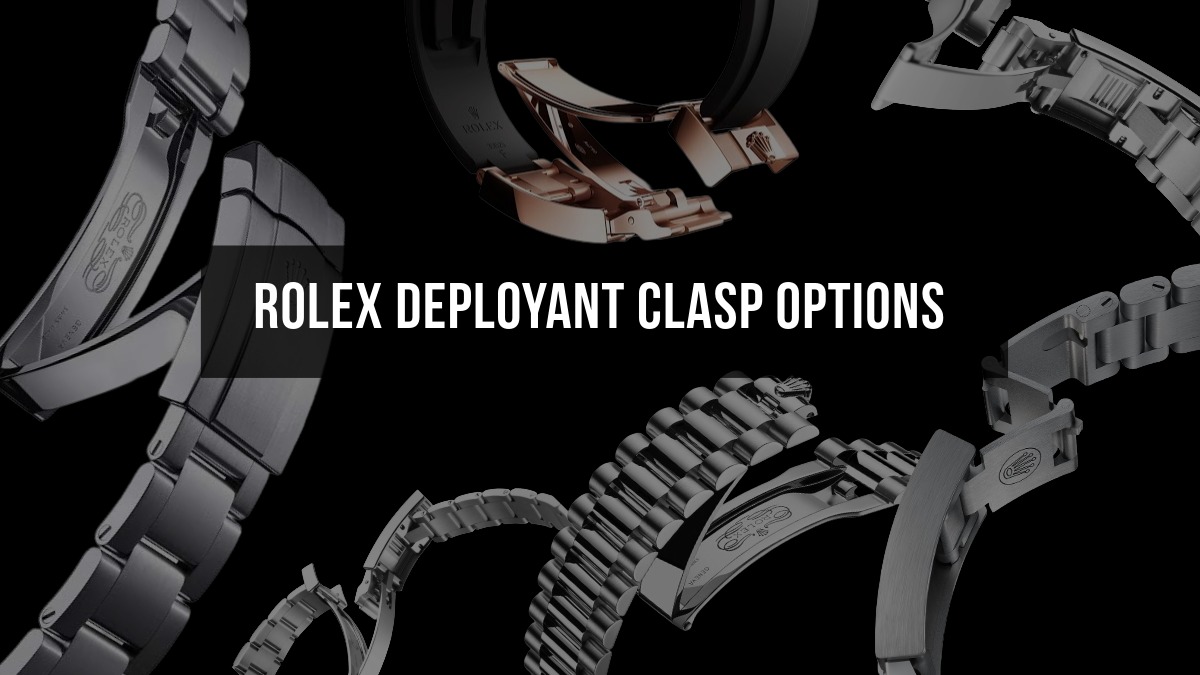
Rolex does not use one universal clasp across its watch collection. The clasp fitted to a particular watch depends on its bracelet, reference, generation and intended purpose.
A Datejust and a Submariner may both be presented on an Oyster bracelet, yet their closure and adjustment systems can be fundamentally different. One may use a folding Oysterclasp with an Easylink comfort extension, while the other may use an Oysterlock safety clasp combined with the Rolex Glidelock fine-adjustment system.
These distinctions affect more than the appearance of the bracelet. The clasp determines how the watch is secured, how its fit can be adjusted and whether a replacement strap can integrate with the original Rolex hardware.
This guide explains Rolex’s principal folding clasps, Oysterclasp, Oysterlock and Crownclasp, along with the Easylink, Glidelock and Fliplock bracelet-extension systems. It also examines representative model configurations and explains why the exact clasp must be confirmed before ordering a model-specific Rubber B strap.
Rolex Clasps and Extension Systems Are Not the Same
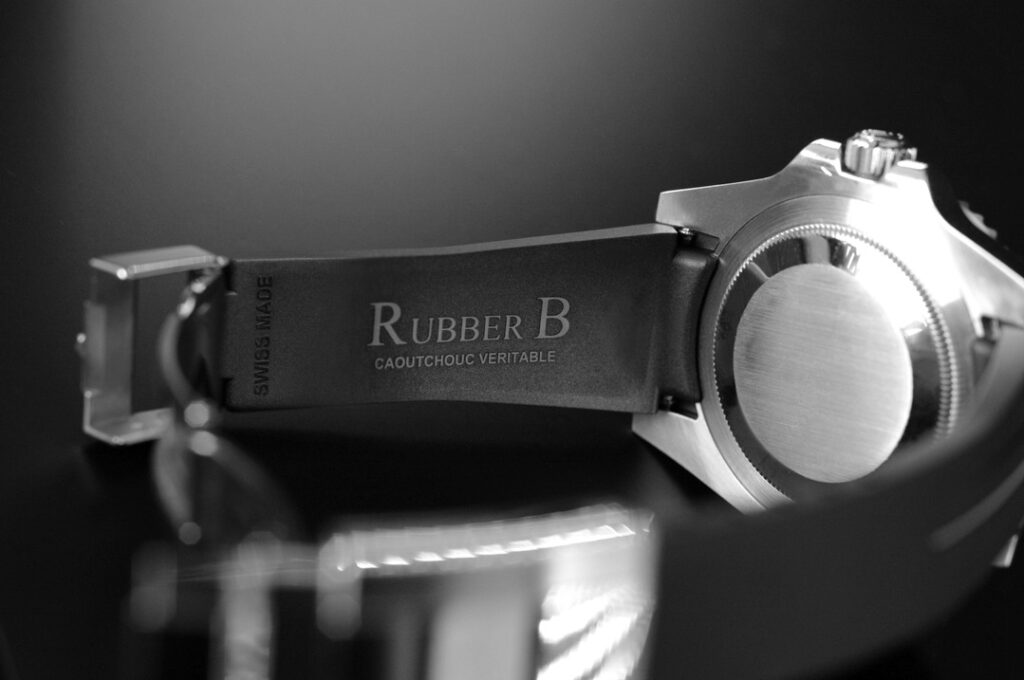
Rolex clasps and Rolex bracelet-extension systems perform related but different functions.
A clasp closes the bracelet and secures the watch to the wrist. An extension system changes the effective length of the bracelet without requiring a permanent link adjustment.
The principal Rolex clasp systems covered in this guide are:
- Oysterclasp
- Oysterlock safety clasp
- Crownclasp
- Dualclasp
The principal Rolex extension systems are:
- Easylink
- Rolex Glidelock
- Fliplock
Easylink, Glidelock and Fliplock are therefore not independent clasps. Each operates within or alongside a compatible Rolex clasp configuration.
This distinction is essential when evaluating bracelet construction or selecting a Rubber B strap designed to integrate with original Rolex hardware.
What Is the Rolex Oysterclasp?
The Oysterclasp is a folding clasp protected by an external cover that opens in a single movement. Rolex describes it as a robust system developed for everyday use, balancing secure closure with straightforward operation.
Unlike the Oysterlock, the Oysterclasp does not include the additional safety catch associated with Rolex Professional watches.
The Oysterclasp can be found on both Oyster and Jubilee bracelets, depending on the watch and reference. It is frequently combined with the Easylink comfort extension system, allowing the bracelet to be lengthened by approximately 5 mm without tools.
Current Datejust 36 and Datejust 41 references provide an important example. Whether configured with an Oyster bracelet or a Jubilee bracelet, many current Datejust models use a folding Oysterclasp combined with Easylink.
This illustrates why the bracelet name alone cannot determine the clasp. A Jubilee bracelet does not automatically indicate the presence of a concealed Crownclasp.
Physical Characteristics of the Oysterclasp
The Oysterclasp can generally be identified by:
- A visible folding clasp body
- An external protective cover
- A single-stage opening action
- No additional flip-over safety catch
- Easylink on compatible configurations
The exact shape, finish and dimensions can vary by reference and production generation.
What Is the Rolex Oysterlock Safety Clasp?
The Oysterlock is a folding safety clasp developed primarily for Rolex Professional watches. Its defining feature is an additional safety catch designed to help prevent accidental opening.
The safety catch creates a two-stage opening sequence. It must first be released before the main folding clasp can be opened.
This added layer of security makes the Oysterlock suitable for watches associated with diving, exploration, aviation, motor racing and other active applications.
Current Rolex models using an Oysterlock include representative configurations within the:
- Submariner collection
- Sea-Dweller collection
- GMT-Master II collection
- Explorer collection
- Explorer II collection
- Air-King collection
- Cosmograph Daytona collection
- Yacht-Master collection
The extension system paired with the Oysterlock depends on the specific watch. A GMT-Master II commonly combines Oysterlock with Easylink, while a Submariner uses Oysterlock with Glidelock. Current Explorer and Air-King documentation also identifies the combination of Oysterlock and Easylink.
Physical Characteristics of the Oysterlock
The Oysterlock can generally be identified by:
- A visible folding clasp
- An additional hinged safety catch
- A two-stage opening sequence
- Frequent use on Professional models
- Easylink or Glidelock, depending on the reference
The presence of an Oyster bracelet does not by itself confirm an Oysterlock. Many non-Professional Rolex watches use an Oyster bracelet with an Oysterclasp instead.
Oysterclasp vs. Oysterlock: What Is the Difference?
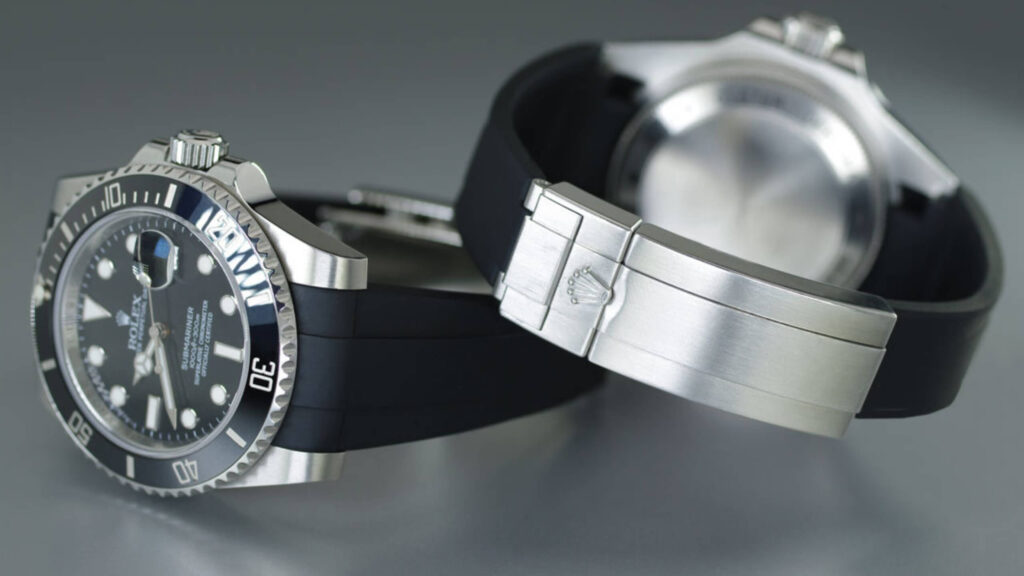
The principal difference is the additional safety catch.
The Oysterclasp is designed for secure everyday closure and opens through its protective cover. The Oysterlock adds a separate safety catch intended to reduce the possibility of accidental opening.
| Feature | Oysterclasp | Oysterlock |
| Folding construction | Yes | Yes |
| Visible clasp cover | Yes | Yes |
| Additional safety catch | No | Yes |
| Typical positioning | Everyday and Classic models | Primarily Professional models |
| Possible extension system | Easylink | Easylink or Glidelock |
| Example current application | Datejust | GMT-Master II or Submariner |
The exact configuration should always be confirmed by reference because Rolex has changed clasp designs and bracelet combinations across generations.
What Is the Rolex Crownclasp?
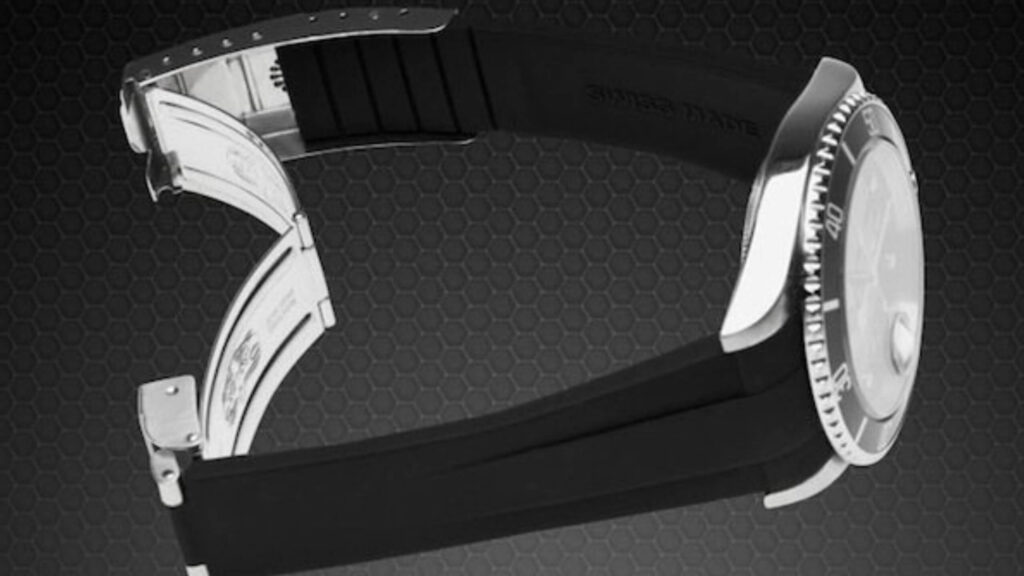
The Crownclasp is a concealed folding clasp designed to blend into the links of the bracelet.
Rolex constructs the Crownclasp with two folding blades and a concealed locking mechanism operated through a crown-shaped lever. When closed, the clasp body is largely hidden, leaving the Rolex coronet as the visible release point.
The Crownclasp is closely associated with the President bracelet of the Day-Date. It has also appeared on selected Jubilee and President bracelet configurations, including certain Lady-Datejust references.
Its concealed architecture creates a nearly uninterrupted visual line around the wrist. This distinguishes it from the visible covers of the Oysterclasp and Oysterlock.
Does Every Jubilee Bracelet Use a Crownclasp?
No.
The Jubilee is a bracelet design, not a clasp specification.
Current Datejust Jubilee bracelets commonly use the folding Oysterclasp with Easylink. Current GMT-Master II Jubilee bracelets use an Oysterlock safety clasp with Easylink. Selected other references may use a concealed Crownclasp.
A Jubilee bracelet may therefore be paired with:
- Oysterclasp
- Oysterlock
- Crownclasp
The exact combination depends on the model, reference and generation.
Physical Characteristics of the Crownclasp
The Crownclasp can generally be identified by:
- A concealed folding mechanism
- Two folding blades
- A crown-shaped release lever
- Minimal interruption across the bracelet links
- Use with selected President, Jubilee and other precious-metal bracelet configurations
Current Day-Date references with President bracelets continue to specify a concealed folding Crownclasp.
What Is the Rolex Dualclasp?
The Dualclasp is a double-folding clasp designed for selected Rolex leather-strap configurations.
Rolex currently identifies the Dualclasp with the leather strap of the Perpetual 1908. Its two-stage folding mechanism is opened through the Rolex crown positioned on the inner side of the wrist.
The Dualclasp is not normally relevant to Rubber B’s principal Rolex sports-watch applications. However, it belongs in a complete explanation of modern Rolex clasp terminology.
It should not be confused with a generic “butterfly clasp.” Dualclasp is Rolex’s designated name for this specific system and application.
What Is Rolex Easylink?
Easylink is a rapid comfort-extension system concealed beneath a compatible clasp.
The system uses a fold-out link that increases the bracelet length by approximately 5 mm. It can be opened or folded back without tools, allowing the wearer to compensate for normal changes in wrist circumference during the day.
Rolex introduced and patented Easylink in 1996.
The system is intended primarily for everyday comfort rather than fitting a watch over professional diving equipment.
A wrist can expand slightly because of heat, activity, humidity or normal circulation. Easylink provides a small adjustment without requiring a bracelet link to be added or removed.
Watches Commonly Associated With Easylink
Representative current applications include:
- Datejust with Oysterclasp
- GMT-Master II with Oysterlock
- Explorer with Oysterlock
- Explorer II with Oysterlock
- Air-King with Oysterlock
Current GMT-Master II models use Easylink with both Oyster and Jubilee bracelet configurations. Both bracelet styles are paired with Oysterlock on the current collection.
Easylink Is Not a Clasp
Easylink cannot close the bracelet independently. It functions inside a compatible clasp.
The complete configuration should therefore be described as:
- Oysterclasp with Easylink
- Oysterlock with Easylink
It should not be described simply as an “Easylink clasp.”
What Is the Rolex Glidelock System?
Rolex Glidelock is a tool-free incremental bracelet-extension system.
Introduced in 2008, the patented system uses a toothed track positioned beneath the clasp cover. Depending on the watch and bracelet configuration, it permits approximately 15 or 20 mm of adjustment in small increments.
On the Submariner, Glidelock enables the bracelet to be adjusted in increments of approximately 2 mm across a total range of roughly 20 mm. This allows the bracelet to fit over a diving suit while also providing precise adjustment for everyday wear.
Glidelock is most closely associated with Rolex dive watches, although versions of the system also appear with selected Oysterflex bracelet configurations.
How Glidelock Works
Glidelock allows the bracelet length to be changed without:
- Removing bracelet links
- Using a spring-bar tool
- Opening the watch case
- Permanently changing the bracelet structure
The wearer opens the clasp, releases the adjustable section and moves it along the toothed track to the preferred position.
The watch should not be described as having a “Glidelock clasp” in the strictest technical sense. A more accurate description is:
Oysterlock safety clasp with Rolex Glidelock extension system.
However, the shorter expression “Glidelock clasp” is frequently used conversationally and within product navigation to identify the complete closure assembly.
Watches Commonly Associated With Glidelock
Representative current applications include:
- Submariner
- Submariner Date
- Sea-Dweller
- Rolex Deepsea
- Deepsea Challenge
- Selected Yacht-Master and Cosmograph Daytona models on Oysterflex
The total adjustment range and mechanism may differ between applications. Compatibility must therefore be confirmed using the exact watch reference rather than the presence of the Glidelock name alone.
What Is the Rolex Fliplock Extension?
Fliplock is an additional fold-out extension system developed for specialized deep-diving applications.
The current Rolex system consists of three folding blades concealed beneath the clasp cover. On the Deepsea Challenge, Fliplock adds approximately 26 mm of length and works alongside Glidelock, allowing the watch to fit over a diving suit up to approximately 7 mm thick.
Unlike Glidelock, which provides incremental fine adjustment, Fliplock adds a larger fixed extension.
The two systems therefore serve different purposes:
- Glidelock: precise incremental adjustment
- Fliplock: substantial additional diving-suit clearance
Fliplock availability has varied across Rolex diving-watch generations. It should not be assigned broadly to every Sea-Dweller or Deepsea without checking the exact reference and production period.
Current Fliplock Application
Rolex’s current technical material specifically associates Fliplock with the Oyster bracelet of the Deepsea Challenge.
Historical models and earlier generations may use different diving-extension constructions. Any article, product listing or compatibility guide should clearly distinguish current specifications from historical configurations.
Representative Rolex Clasp Configurations by Model
The following table presents representative current configurations. It is not a universal compatibility database.
| Rolex model or collection | Typical current bracelet | Clasp | Extension system | Important qualification |
| Datejust 36 and 41 | Oyster or Jubilee | Oysterclasp | Easylink | Confirm exact reference and generation |
| Lady-Datejust | Oyster, Jubilee or President | Oysterclasp or Crownclasp | Configuration-dependent | Material and bracelet affect the clasp |
| Day-Date | President | Crownclasp | No conventional comfort extension normally specified | Confirm exact reference |
| GMT-Master II | Oyster or Jubilee | Oysterlock | Easylink | Both current bracelet styles use Oysterlock |
| Explorer | Oyster | Oysterlock | Easylink | Historical configurations vary |
| Explorer II | Oyster | Oysterlock | Easylink | Confirm reference and case generation |
| Air-King | Oyster | Oysterlock | Easylink | Current Professional configuration |
| Cosmograph Daytona | Oyster or Oysterflex | Oysterlock | Easylink or Glidelock, depending on configuration | Confirm bracelet and reference |
| Submariner | Oyster | Oysterlock | Glidelock | Reference-specific strap fit |
| Sea-Dweller | Oyster | Oysterlock | Glidelock | Diving-extension details vary by generation |
| Rolex Deepsea | Oyster | Oysterlock | Glidelock | Confirm current versus historical reference |
| Deepsea Challenge | Oyster | Oysterlock | Glidelock and Fliplock | Specialized deep-diving configuration |
| Yacht-Master | Oyster or Oysterflex | Oysterlock | Easylink or Glidelock, depending on reference | Confirm case size and material |
| Perpetual 1908 on leather | Leather strap | Dualclasp | None | Separate from the principal sports-watch systems |
Rolex currently specifies an Oysterclasp with Easylink on representative Datejust Jubilee configurations, while a current GMT-Master II Jubilee uses Oysterlock with Easylink. The Day-Date President bracelet uses Crownclasp, and the Submariner combines Oysterlock with Glidelock.
Why the Rolex Reference and Generation Matter
Model names often remain in production for decades, while their bracelets, clasps and case dimensions evolve.
A vintage Submariner and a current Submariner may share the same model name but use different:
- Lug dimensions
- End-link architecture
- Spring-bar positions
- Bracelet screws
- Clasp widths
- Diving extensions
- Adjustment systems
The same is true across the Datejust, GMT-Master II, Explorer, Sea-Dweller and Daytona collections.
Even watches with the same nominal case diameter may not share interchangeable straps. A 40 mm case measurement alone does not establish compatibility.
For this reason, any clasp or strap identification should begin with the exact reference number.
The reference can normally be confirmed through:
- The original Rolex warranty card
- Original purchase documentation
- Service documentation
- The engraved rehaut on supported generations
- Inspection between the lugs on certain older references
- Verification through an authorized Rolex service source
The exterior case back should not be relied upon as the primary source of the watch reference.
Rolex Bracelet Names Do Not Determine the Clasp
Rolex bracelet terminology and clasp terminology should always be treated separately.
The principal Rolex bracelet families include:
- Oyster
- Jubilee
- President
- Oysterflex
- Flat Jubilee
- Settimo
- Leather straps on selected references
An Oyster bracelet can be paired with an Oysterclasp or an Oysterlock. A Jubilee bracelet can be paired with an Oysterclasp, Oysterlock or Crownclasp. A President bracelet is strongly associated with Crownclasp, but the exact watch configuration should still be verified.
The bracelet describes the link structure or strap construction. The clasp describes the closure.
For a more detailed explanation of Oyster, Jubilee, President and Oysterflex architecture, see Rubber B’s guide to the different types of Rolex bracelets.
Internal-link anchor: What Are the Different Kinds of Rolex Bracelets?
Original Rolex Clasp Compatibility With Rubber B
Rubber B produces model-specific straps using several closure configurations.
The available system depends on the exact Rolex reference and the Rubber B product selected. A Rubber B strap should never be chosen according to case diameter or bracelet name alone.
Rubber B Classic Series
On compatible references, the Rubber B Classic Series is designed to integrate with the original Rolex deployant clasp supplied with the watch.
The Rolex clasp is removed from the factory bracelet and mounted directly to the compatible Rubber B strap. The clasp is not included with the strap.
The Classic Series should not be interpreted as universally compatible with every Rolex Oysterclasp, Oysterlock or Crownclasp. The mounting dimensions differ across models and generations.
Compatibility must be verified on the product page for the exact watch reference.
Rubber B Glidelock Series
The Rubber B Glidelock Series is engineered for selected Rolex references equipped with the original Rolex Glidelock assembly.
The strap mounts to the watch case and the customer’s original Rolex clasp without using links from the metal Oyster bracelet.
Rubber B Glidelock Series sizing is based on the original Oyster bracelet link count. This method helps reproduce the position of the clasp and watch head around the wrist after the metal links are removed.
Selected Carbon Fiber Series straps use Rubber B’s Strength Infusion Technology. Carbon-fiber material is incorporated into the vulcanized rubber construction to increase resistance to vertical and lateral stress in applications exposed to clasp friction, watch weight and frequent Glidelock adjustments.
This feature applies to selected products and should not be assumed across every Rubber B Glidelock-compatible strap.
Rubber B Tang Buckle Series
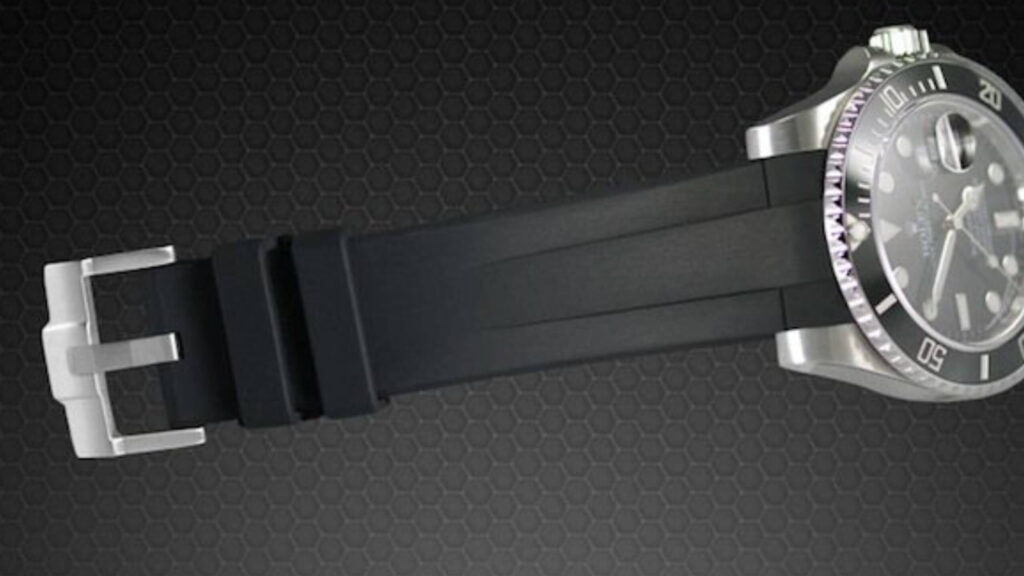
The Tang Buckle Series uses a Rubber B 316L stainless-steel tang buckle rather than the original Rolex deployant clasp.
This can provide an alternative when:
- The original Rolex clasp is not compatible
- The wearer prefers a conventional buckle
- A different sizing or closure experience is desired
- The factory bracelet and clasp are to remain assembled
The buckle is supplied with the compatible Tang Buckle Series strap.
Rubber B Velcro® Series
The Velcro® Series uses an industrial-strength Velcro® closure with a titanium loop on compatible products.
Sizing is based on wrist circumference rather than the original Rolex bracelet link count.
Rubber B SwimSkin® Integrated Series
Selected SwimSkin® Integrated products use sizing based on the original Oyster bracelet link count and may integrate with compatible original Rolex clasp systems.
The precise closure and sizing requirements must be confirmed on the product page for the selected watch.
How the Rolex Clasp Affects Rubber B Ordering
The clasp affects four important ordering decisions.
1. Product-Series Compatibility
A Classic Series strap and a Glidelock Series strap are not automatically interchangeable.
A strap developed for an Oysterlock-and-Glidelock Submariner uses different clasp-side engineering from a strap developed for a Datejust Oysterclasp.
The correct Rubber B product series must be selected before choosing the color or size.
2. Clasp-Side Mounting Dimensions
Rolex clasp components differ in width, screw placement, terminal-link architecture and internal geometry.
A similar external appearance does not establish compatibility.
The original clasp must connect to the Rubber B strap at the designated mounting point without forcing, cutting or modifying the rubber.
3. Sizing Method
Rubber B sizing varies by product family.
- Glidelock Series: based on original Oyster bracelet link count
- SwimSkin® Integrated Series: based on original bracelet link count where specified
- Velcro® Series: based on wrist circumference
- Classic Series: product-specific sizing or a stated fit range
- Tang Buckle Series: product-specific holes and wrist range
The product page and size guide should always take precedence over general assumptions.
4. Retention of Rolex Adjustment Features
A compatible original-clasp strap may preserve access to the adjustment system built into the Rolex clasp.
For example, a properly engineered Glidelock Series strap is designed to work with the customer’s original Rolex Glidelock assembly.
Whether Easylink, Glidelock or another feature remains available depends on the exact strap, clasp and reference combination.
How to Identify a Rolex Clasp Before Ordering
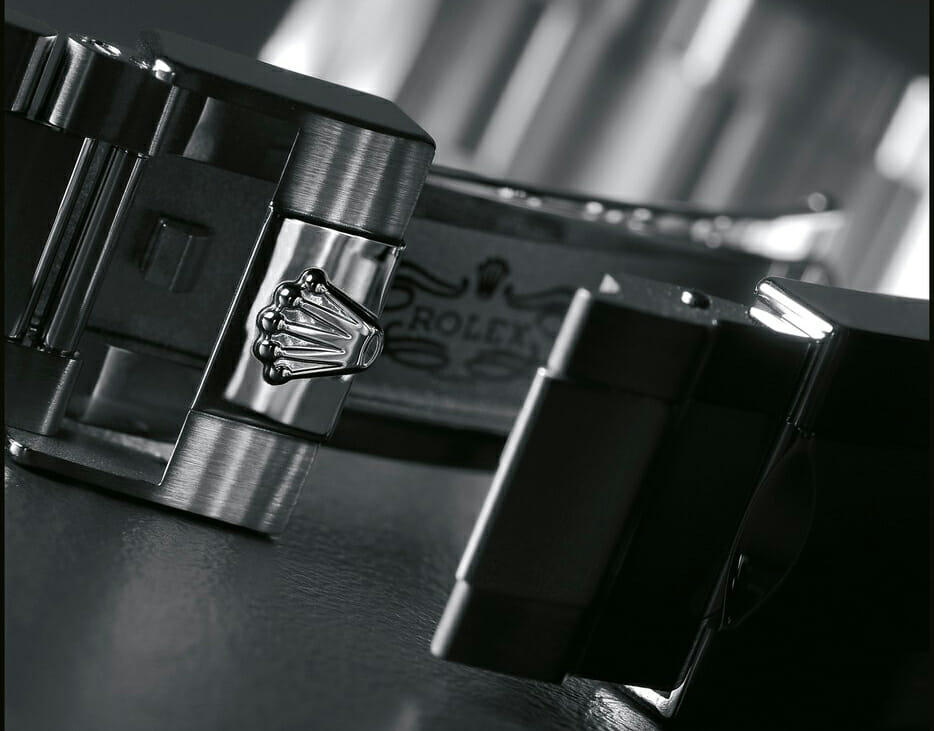
The following visual process can help distinguish the principal systems.
Step 1: Examine the Outer Clasp
A visible folding cover without a separate safety catch may indicate an Oysterclasp.
A visible clasp with an additional flip-over safety catch is more likely an Oysterlock.
A nearly uninterrupted bracelet with only a crown-shaped release point may indicate a Crownclasp.
Step 2: Open the Clasp
Once opened, examine the internal adjustment system.
- A fold-out link offering approximately 5 mm suggests Easylink.
- A toothed track with multiple incremental positions suggests Glidelock.
- Three larger folding extension blades on the Deepsea Challenge indicate Fliplock.
- A concealed two-blade system operated by the coronet may indicate Crownclasp.
Step 3: Confirm the Bracelet
Identify whether the watch uses:
- Oyster
- Jubilee
- President
- Oysterflex
- Leather
- Another current Rolex bracelet
Do not use the bracelet alone to determine the clasp.
Step 4: Confirm the Reference
Use the warranty card, purchase documentation, service records or another reliable reference source.
Step 5: Check the Rubber B Product Listing
The exact watch reference must appear in the compatibility information for the selected Rubber B strap.
A product should not be ordered solely because another watch in the same collection uses a similar clasp.
Common Rolex Clasp Identification Mistakes
Assuming Every Oyster Bracelet Uses an Oysterclasp
The Oyster bracelet is used with both Oysterclasp and Oysterlock configurations.
The Datejust commonly uses Oysterclasp, while the Submariner and GMT-Master II use Oysterlock in current configurations.
Assuming Every Jubilee Bracelet Uses Crownclasp
Current Datejust Jubilee bracelets commonly use Oysterclasp. Current GMT-Master II Jubilee bracelets use Oysterlock.
The Crownclasp appears only on selected configurations.
Calling Glidelock a Standalone Clasp
Glidelock is an extension system. On Rolex dive watches, it is commonly integrated into an Oysterlock clasp assembly.
Assuming All 40 mm Rolex Watches Share a Strap
Case diameter alone does not establish lug geometry, clasp compatibility or strap fit.
Identifying the Reference From the Case Back
Most Rolex references are not visibly printed on the external case back. Documentation or another verified identification method should be used.
Ordering by Model Name Alone
“Submariner,” “Datejust” or “GMT-Master II” is not sufficiently precise. The reference and generation must be confirmed.
Frequently Asked Questions
What is the difference between Rolex Oysterclasp and Oysterlock?
Oysterclasp is a folding clasp protected by an external cover. Oysterlock adds a separate safety catch designed to help prevent accidental opening. Oysterlock is primarily associated with Rolex Professional watches.
Is Rolex Glidelock a clasp?
No. Rolex Glidelock is an extension system integrated beneath a compatible clasp cover. On watches such as the Submariner, it operates with the Oysterlock safety clasp.
What is the difference between Easylink and Glidelock?
Easylink provides approximately 5 mm of quick comfort adjustment through a fold-out link. Glidelock provides incremental adjustment across a larger range—approximately 15 or 20 mm depending on the configuration.
Does every Rolex Jubilee bracelet use a Crownclasp?
No. Current Datejust Jubilee bracelets commonly use Oysterclasp with Easylink, while current GMT-Master II Jubilee bracelets use Oysterlock with Easylink. Crownclasp appears on selected Jubilee configurations.
Which clasp does the Rolex Submariner use?
Current Submariner references use an Oysterlock safety clasp combined with the Rolex Glidelock extension system.
Which clasp does the Rolex Datejust use?
Representative current Datejust 36 and Datejust 41 references use a folding Oysterclasp with Easylink on both Oyster and Jubilee bracelet configurations. Other sizes and historical generations should be checked individually.
Which clasp does the Rolex GMT-Master II use?
Current GMT-Master II references use an Oysterlock safety clasp with Easylink on both Oyster and Jubilee bracelets.
Which clasp does the Rolex Day-Date use?
Current Day-Date references with the President bracelet use a concealed folding Crownclasp.
Does Rubber B work with the original Rolex clasp?
Selected Rubber B products are engineered to use the customer’s original Rolex clasp. The Classic Series supports the original deployant clasp on compatible references, while the Glidelock Series supports the original Glidelock assembly on designated Rolex models.
Other Rubber B products use a Rubber B tang buckle, Velcro® closure or another specified system.
Is the original Rolex clasp included with a Rubber B strap?
No. When a Rubber B product is designed for the original Rolex clasp, the clasp must be transferred from the customer’s factory bracelet.
How is a Rubber B Glidelock strap sized?
The Glidelock Series is sized according to the link count of the original Rolex Oyster bracelet. The metal links are not used after installation; the count is used to select the appropriate strap size.
Can the Rolex diving extension remain attached?
The answer depends on the exact Rolex reference, clasp, Rubber B product and desired sizing. Product-specific installation instructions should be followed.
Can a Rubber B strap be modified to fit another Rolex clasp?
No. A Rubber B strap should not be cut, drilled, forced, or altered to fit a clasp or watch reference that is not listed as compatible.
Choosing the Correct Rolex Clasp Configuration
Rolex clasps are not interchangeable labels for the same mechanism.
Oysterclasp provides a secure folding closure for many everyday configurations. Oysterlock adds an additional safety catch for Professional models. Crownclasp conceals its folding mechanism within selected bracelet designs. Easylink provides rapid comfort adjustment, while Glidelock offers precise incremental sizing. Fliplock extends the bracelet for specialized deep-diving use.
Understanding these differences is essential when identifying a Rolex bracelet, evaluating fit or choosing a model-specific replacement strap.
Rubber B straps are engineered around exact watch and clasp architectures rather than generic lug widths. The watch reference, original clasp, closure preference and product-specific sizing method should all be confirmed before ordering.
That reference-specific approach preserves the security, proportions and functionality expected from a luxury sports watch while allowing the original bracelet to be replaced with a Swiss-Made vulcanized rubber configuration developed for the designated timepiece.
Follow Us on Instagram