Introduction: A Watch Born for War, Refined for Collectors
Panerai stands apart in the world of horology. While most luxury watchmakers began as jewelers or decorative artisans, Panerai was born from necessity, engineered as a precision instrument for military use. Its identity is rooted not in salons or boutiques, but in underwater missions, naval command, and functional design.
From a modest workshop in Florence to global recognition at Watches & Wonders 2025, Panerai has maintained a distinct visual language: oversized cushion cases, highly legible dials, and uncompromising durability. These are not stylistic choices, they are the direct result of a mission-driven origin.
For collectors today, Panerai represents something rare: a luxury watch brand whose DNA is entirely authentic. Understanding its history is essential to understanding why its watches, and their straps, remain unlike anything else in the industry.
The Florence Origins: 1860–1915
Panerai’s story begins in 1860, when Giovanni Panerai opened a watchmaking shop on the Ponte alle Grazie in Florence. The workshop served multiple roles: retail space, repair center, and one of Italy’s earliest watchmaking schools.
Florence, rather than Switzerland, shaped Panerai’s identity. Italian design emphasized boldness, clarity, and proportion over ornamentation. This philosophy would later define every Panerai watch.
By the early 20th century, the Panerai workshop had evolved into a trusted supplier of precision instruments to the Italian Royal Navy. This relationship would become the foundation of the brand’s future.
The Radiomir Era: 1916–1954
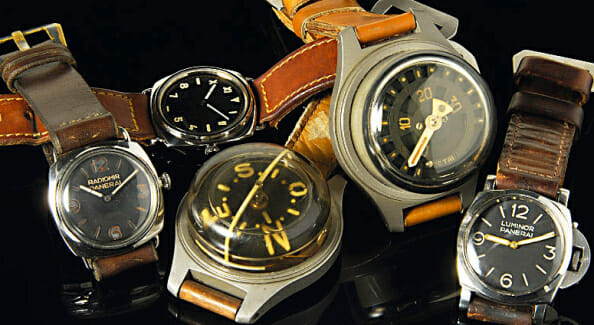
Looking closely at a Panerai timepiece, we notice an endearing and inherent design which dates back to the 1930s. Unique shapes, oversized glass domes, and distinctly masculine curves have defined the Italian brand for over 80 years. Transcending generations, and commanding devotion from simple fans to the rich and famous alike, it is hard to imagine Giovanni Panerai in his small watch shop in Florence, fabricating and perfecting his craft so long ago on the Ponte alle Grazie. His Grandson, Guido eventually took over the shop and propelled the company onward and upward.
Times were simpler, which gave ample hours of creativity for Guido to experiment with new technologies and innovations. Having already patented a process for luminescent watch marking on equipment for the Italian Navy, which he aptly named “Radiomir“, he was further commissioned by the Italian Royal Navy to produce a series of precision instruments for strategic use underwater. This eventually lead to Panerai producing a military divers’ watch which could be easily read and function reliably in dark aquatic depths. The original material used for such markings was radioactive, but was later changed to a safer material on the next generation Panerai watch known as “Luminor“.
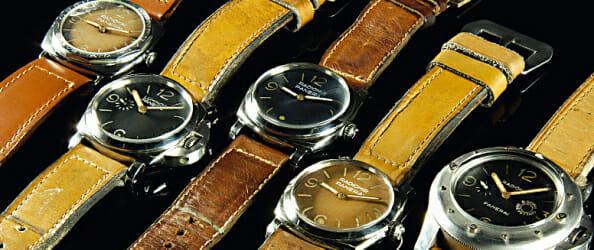
Surprisingly, the first Panerai watches in 1935 were made by Rolex for Panerai – a partnership that would last until 1954. These Panerai watches were developed from Rolex pocket watches (ref. 2533) with a large 47mm case. It was also in partnership with Rolex, that Panerai developed its distinctive crown guard. Early versions of Panerai which contain the Rolex movement and insignia on the crown are highly sought ofter rarities, which are worth hundreds of thousands of dollars to collectors.
After the War, Panerai continued to provide diving watches for the Italian Navy, however they were only producing limited numbers, and then fairly exclusively for the military. By the 1990s their association with the Navy was proving to be no longer cost effective, and the company seemed to be standing on shaky ground. In 1997, Richemont, the Swiss luxury goods company, took over Officine Panerai and has since culminated it’s mass appeal in the luxury sector.
For even more interesting information, check out Jake Ehrlich’s fantastic article about Panerai watches on Jakes Rolex World.
In 1916, Guido Panerai patented a luminescent compound known as Radiomir, designed to enhance visibility in low-light underwater conditions. This innovation marked the beginning of Panerai’s transformation from watchmaker to military supplier.
By 1935, Panerai developed its first prototype dive watch for Italian naval commandos. These watches were produced with assistance from Rolex, using modified pocket watch movements (Ref. 2533) housed in oversized 47mm cases.
Key Characteristics of Early Radiomir Watches:
- Cushion-shaped cases for durability
- Wire lugs for strap attachment
- Highly legible sandwich dials
- Oversized crowns for gloved operation
The partnership with Rolex (1935–1954) remains one of the most significant aspects of Panerai’s history. Early examples featuring Rolex movements and signed components are now among the most collectible military watches in existence, often commanding six-figure auction results.
These watches were never intended for civilian use. They were tools, engineered for underwater missions, secrecy, and survival.
The Birth of Luminor: 1940s–1960s
Radiomir’s radium-based compound, while effective, posed long-term safety risks. In response, Panerai developed a safer tritium-based alternative: Luminor.
This transition marked one of the most important design evolutions in watch history.
Defining Innovations of the Luminor Era:
- Crown-Protecting Bridge: A patented locking mechanism designed to improve water resistance
- Thicker Case Construction: Increased durability for extreme conditions
- Refined Sandwich Dial: Enhanced legibility and depth
The reference 6152/1 became the blueprint for modern Panerai design. Its crown guard, bold proportions, and minimalist dial layout remain instantly recognizable today.
The Luminor was not an aesthetic update; it was a technical advancement driven by real-world use.
The Secret Years: 1960s–1993
For more than three decades, Panerai operated in near-total obscurity.
Production remained limited and almost entirely dedicated to military contracts. The brand had no public presence, no advertising, and no commercial distribution. This secrecy created a unique phenomenon: a luxury watch brand that existed without a consumer market.
During this period:
- Panerai watches were issued exclusively to Italian Navy divers
- Production numbers remained extremely low
- Knowledge of the brand was confined to military circles
This era helped establish Panerai’s cult status. When collectors eventually discovered the brand, its authenticity was unquestionable.
Going Civilian: 1993–1997
Panerai entered the civilian market in 1993 with a limited release of Luminor and Radiomir models. The response was immediate and intense.
Collectors were drawn to:
- The oversized case design
- The military heritage
- The rarity of production
A pivotal moment came when Sylvester Stallone wore a Panerai Luminor in the film Daylight. His influence introduced the brand to a global audience and helped position Panerai as a bold, masculine alternative to traditional luxury watches.
In 1997, Richemont acquired Officine Panerai. This marked the beginning of a new era, one that would transform the brand into a global luxury powerhouse while preserving its core identity.
The Modern Era: Collections Defined
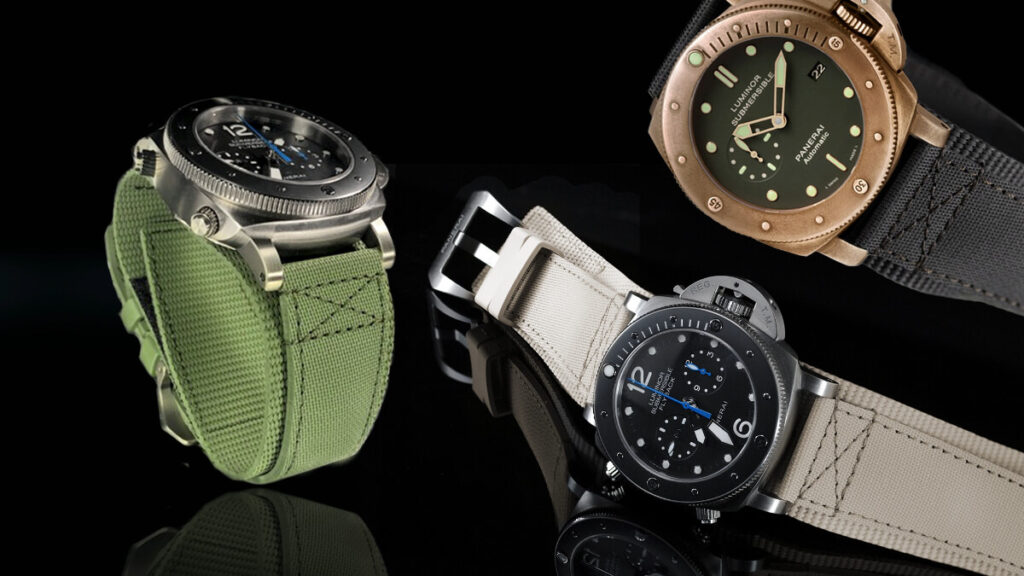
Today, Panerai’s lineup is structured into distinct collections, each rooted in its historical foundations.
Luminor
The flagship collection, defined by:
- Crown-protecting bridge
- Cushion-shaped case
- Strong presence on the wrist
Radiomir
The most historically faithful line:
- Wire lugs
- Slimmer profile
- Vintage-inspired aesthetics
Luminor Due
Introduced in 2016:
- Thinner case design
- More refined, dress-oriented appeal
Submersible
Separated as its own collection in 2019:
- Professional dive watch capabilities
- Rotating bezel
- Enhanced water resistance
In-House Movements
Panerai has increasingly shifted toward manufacture calibers, including:
- P.5000 (8-day power reserve)
- P.9012 (GMT functionality)
- P.9100 (chronograph movement)
This transition has strengthened Panerai’s position as a true manufacture brand.
2023–2025: A New Chapter
Panerai’s recent releases reflect a renewed focus on both heritage and innovation.
Radiomir Revival (2023–2024)
- Radiomir Otto Giorni
- Radiomir Quaranta
- Radiomir Complicazioni
These models emphasize vintage proportions while incorporating modern materials and movements.
Watches & Wonders 2025 Highlights
- Redesigned Luminor Marina collection
- New Calibre P.980 (28,800 vph, 3-day power reserve)
- Cases 12% thinner and significantly lighter
- Titanium versions up to 40% lighter
- 500-meter water resistance (a first for core Luminor models)
- Super-LumiNova X2 for enhanced luminosity
PAM Click Release System
A major innovation allowing tool-free strap changes, transforming how Panerai owners personalize their watches.
This evolution aligns directly with the growing demand for interchangeable, high-performance straps.
Panerai Straps: Function First, Then Evolution
The original Panerai strap was purely functional, a thick leather band designed to secure a large watch during underwater operations.
However, Panerai’s oversized case dimensions (44mm, 47mm) place unique demands on strap performance:
- Structural integrity
- Comfort under weight
- Resistance to water and wear
As modern collectors began wearing Panerai in everyday settings, the limitations of traditional leather became apparent, particularly in humid or aquatic environments.
This shift led to the rise of rubber as a preferred material for Panerai straps.
The Modern Standard: Precision-Fit Rubber Straps
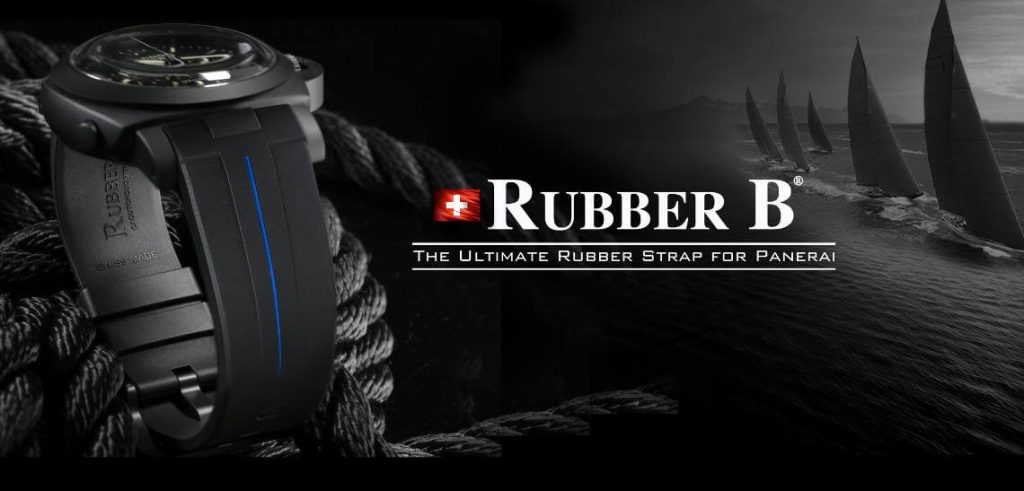
Rubber B redefined what a rubber strap could be for luxury watches. Rather than generic aftermarket solutions, each strap is engineered for a specific Panerai reference.
Key advantages include:
- Swiss-made vulcanized rubber construction
- Seamless integration with Panerai cases
- Enhanced durability for active wear
- Refined aesthetics suitable for both sport and formal settings
With the introduction of the PAM Click Release system, the ability to switch between strap styles has become central to the Panerai ownership experience.
A Panerai is no longer a single watch, it is a platform for personalization
Frequently Asked Questions
When was Panerai founded?
Panerai was founded in 1860 in Florence, Italy, by Giovanni Panerai.
What is the difference between Radiomir and Luminor?
Radiomir features wire lugs and a slimmer case, while Luminor includes the crown-protecting bridge and a more robust construction.
Why did Panerai make watches for the Italian Navy?
Panerai specialized in precision instruments and developed watches specifically for underwater military missions requiring high legibility and durability.
What is the crown-protecting device?
It is a patented lever mechanism that locks the crown in place, improving water resistance and protecting the movement.
What are the most collectible vintage Panerai watches?
Early Radiomir models produced with Rolex movements (1930s–1950s) are among the most valuable and sought-after.
What is the PAM Click Release system?
A modern system introduced by Panerai that allows straps to be changed without tools.
What strap fits a Panerai Luminor?
Strap compatibility depends on the specific reference, but precision-fit rubber straps engineered for Luminor cases provide the best integration and performance.
Why Panerai Endures
Panerai’s enduring appeal lies in its authenticity. Few brands can claim a history so deeply tied to real-world function, military innovation, and uncompromising design.
From Florence to Watches & Wonders 2025, Panerai has evolved without losing its identity. Its watches remain bold, purposeful, and instantly recognizable.
For modern collectors, the experience extends beyond the watch itself. The ability to adapt, personalize, and enhance a Panerai through high-performance straps reflects the same spirit of innovation that defined its origins.
A Panerai was never meant to be subtle. It was built to perform, and to be worn accordingly.
Follow Us on Instagram