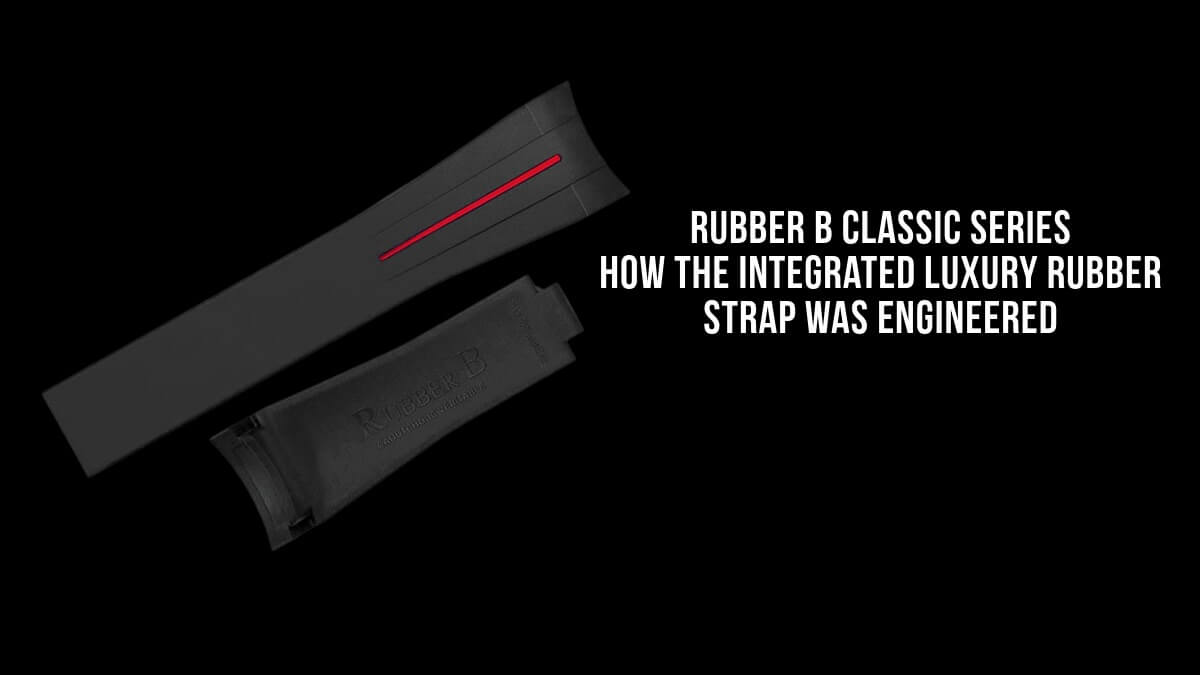
Luxury watches are built around precision. The case, lugs, bracelet, clasp and movement are engineered as elements of a complete object rather than independent components. For many years, however, replacement rubber straps rarely followed the same philosophy.
Rubber B approached the luxury rubber watch strap differently.
Rather than creating a generic strap capable of fitting numerous watches, Rubber B developed straps calibrated around the architecture of individual timepieces. The objective was not simply to replace a metal bracelet with rubber. It was to make the strap appear and function as an extension of the watch itself.
That philosophy became fundamental to the Rubber B Classic Series and to the development of technologies including Blocked Integration™, VulChromatic®, SwimSkin®, Strength Infusion Technology and, more recently, the Dream Strap® with MeshMatic® technology.
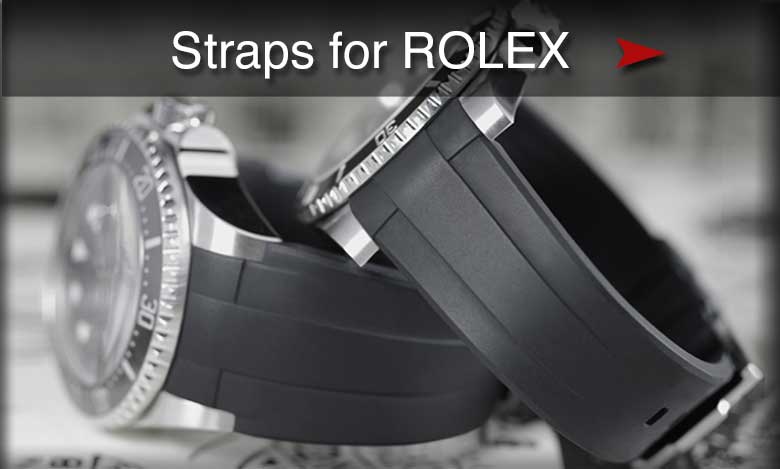
Rubber B traces its origins to 2010, with its first Rolex-focused collection launching in April 2011 for Daytona and Submariner models. Those early straps were engineered specifically around the watch case and Rolex deployant Oyster clasp, helping establish the model-specific approach that continues throughout the Rubber B collection today.
The result was an important change in the relationship between a luxury watch and an aftermarket rubber strap.
A strap no longer needed to look like an addition to the watch.
It could be engineered around it.
The Origins of the Rubber B Classic Series
Rubber straps have a long history in professional diving watches, sports watches and other purpose-built timepieces. Their resistance to water and practicality made them natural equipment for active environments.
Historically, however, rubber was frequently treated as a utilitarian material rather than a luxury one.
A finely finished Swiss watch could feature carefully shaped lugs, polished case surfaces and a precisely engineered metal bracelet, only for an aftermarket strap to leave visible spaces between the strap and the watch case.
Rubber B was developed around a different proposition.
If the watch itself was engineered to exact dimensions, its rubber strap should be treated with comparable attention to geometry, materials and fit.
The early Rubber B designs were therefore developed for specific luxury-watch cases rather than around a generic lug width alone. The company states that its products are designed, manufactured and hand-finished in Switzerland and calibrated for particular luxury watches and clasps.
This model-specific philosophy became one of the defining characteristics of the Classic Series.
Instead of seeing the strap simply as the component connecting a watch to the wrist, Rubber B treated it as part of the architecture surrounding the watch head.
What Is the Rubber B Classic Series?
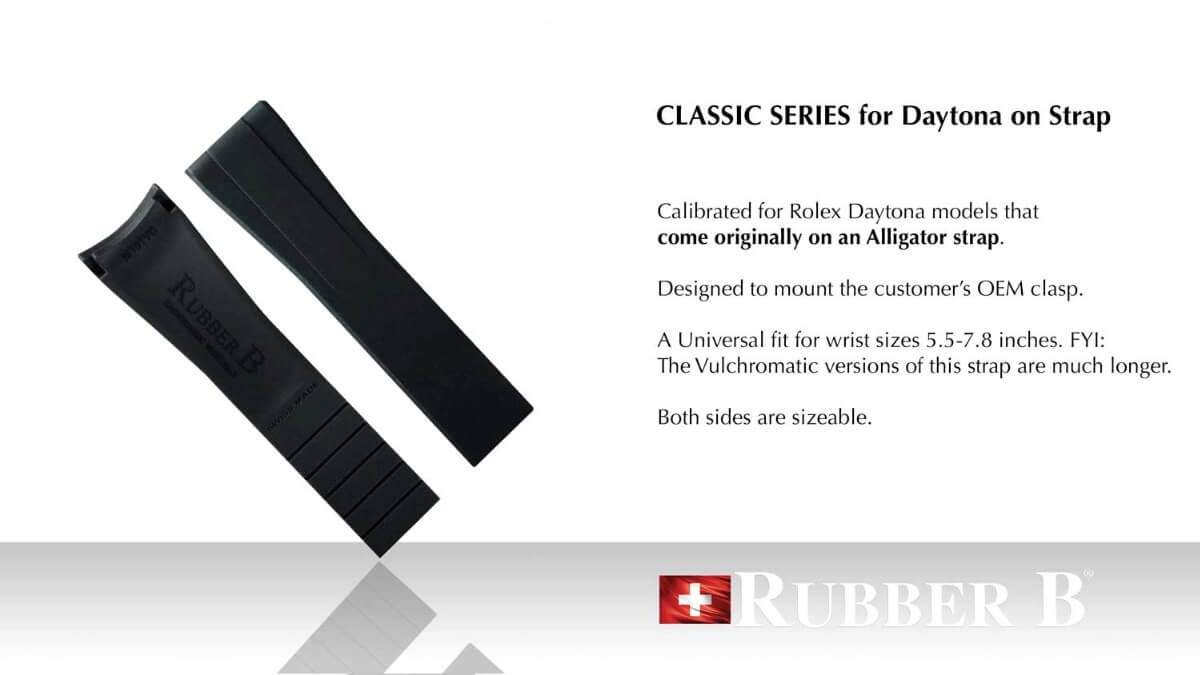
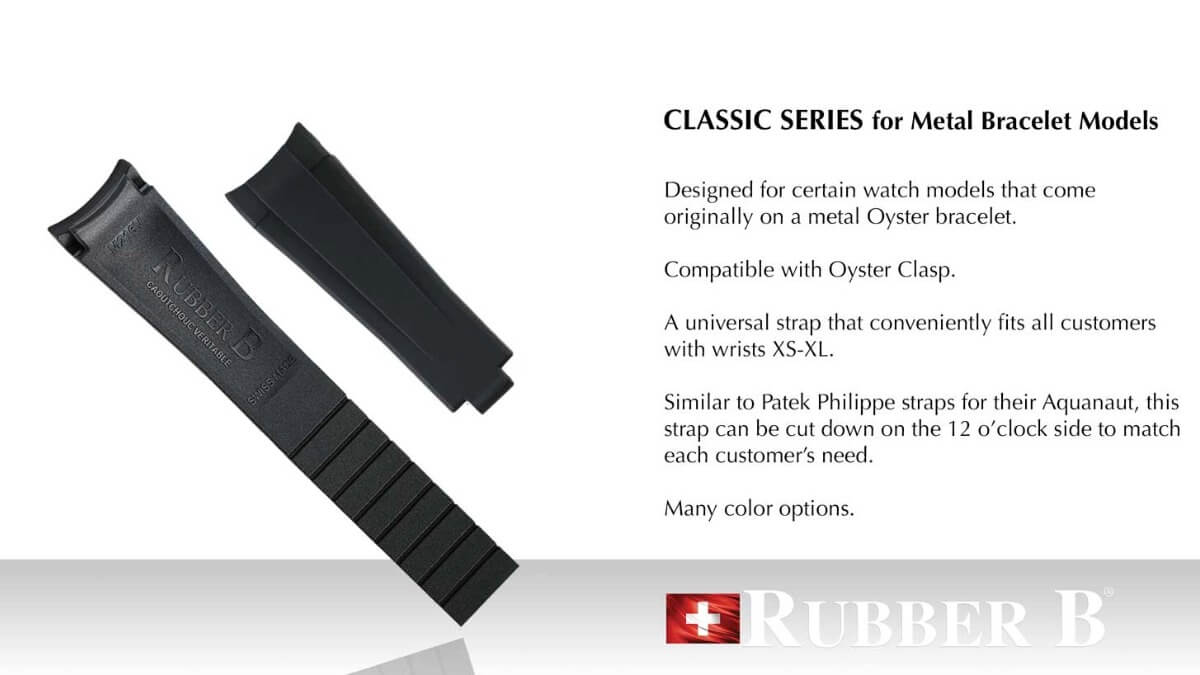
The Rubber B Classic Series represents one of the brand’s foundational strap configurations.
Depending on the watch model, the Classic Series is engineered to integrate with the original manufacturer’s deployant clasp while establishing a flush relationship between the rubber strap and the watch case.
For Rolex watches, for example, Classic Series configurations have been produced to work with original Oyster deployant clasps on compatible references. Similar model-specific engineering principles have subsequently been applied to other luxury watch families.
This approach preserves an important part of the original wearing experience: the watch owner can retain compatible factory clasp hardware while changing the material surrounding the wrist from metal to Swiss-made vulcanized rubber.
The distinction is significant.
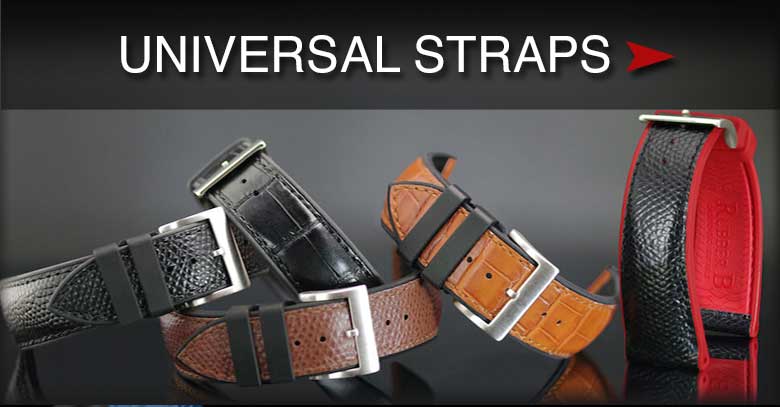
A conventional universal rubber strap is generally selected according to the width between the lugs. A model-specific Rubber B strap must account for considerably more.
The geometry of the case matters.
The curvature of the strap matters.
The location of the spring bar matters.
The interface between rubber and clasp matters.
Even small dimensional differences can determine whether a strap sits naturally against the watch or appears disconnected from it.
That attention to the complete interface became central to Rubber B engineering.
Blocked Integration™: Engineering the Strap Around the Watch
At the center of many Rubber B model-specific designs is Blocked Integration™.
The principle is straightforward: the strap is calibrated to a particular watch case instead of being designed to accommodate a broad range of unrelated references.
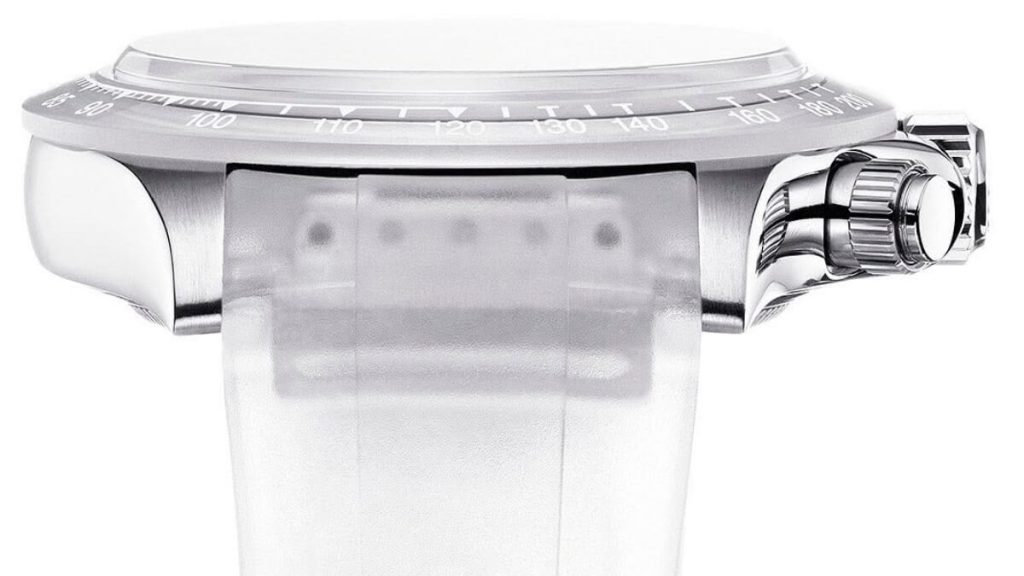
Internally, certain Rubber B straps incorporate solid inserts that establish structure at the connection between the strap, spring bar and watch case. Rubber B describes these inserts as being micro-calibrated to achieve a tight, stable and gap-free relationship with the intended watch.
This is important because the point where the strap meets the case carries both visual and mechanical responsibilities.
A Flush Visual Transition
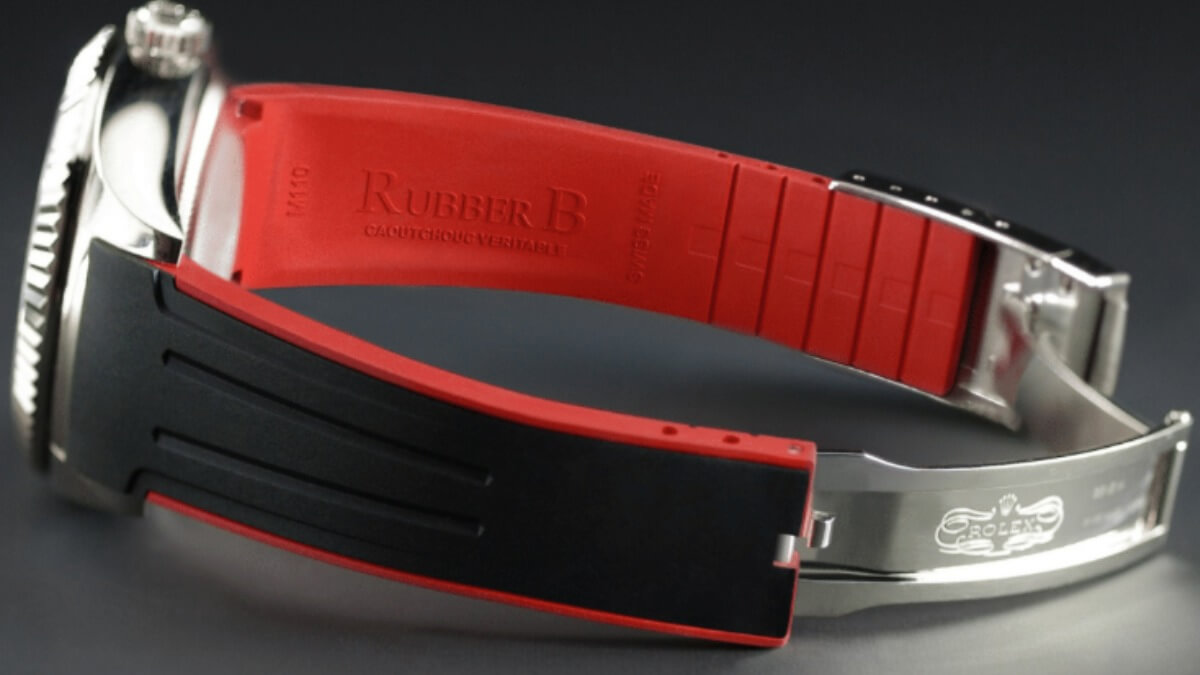
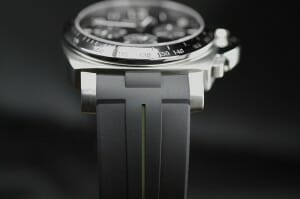
On a conventional straight-end strap, open space may remain visible between the strap and the case.
That appearance can be entirely appropriate on traditional watches designed around conventional leather straps.
It is less natural on a modern sports watch whose case and bracelet were originally designed to create a continuous visual form.
Blocked Integration™ addresses that distinction by shaping the strap around the geometry of the intended watch.
The effect is a more continuous transition from case to strap.
Controlled Movement
Integration is not purely aesthetic.
The area surrounding the spring bar is also subjected to movement and load as the watch is placed on the wrist, removed and worn throughout the day.
Model-specific inserts help control the relationship between the strap and watch head rather than relying solely upon soft rubber surrounding the spring bar.
The objective is a secure connection that remains supple around the wrist while maintaining structure where structure is required.
Model-Specific Calibration
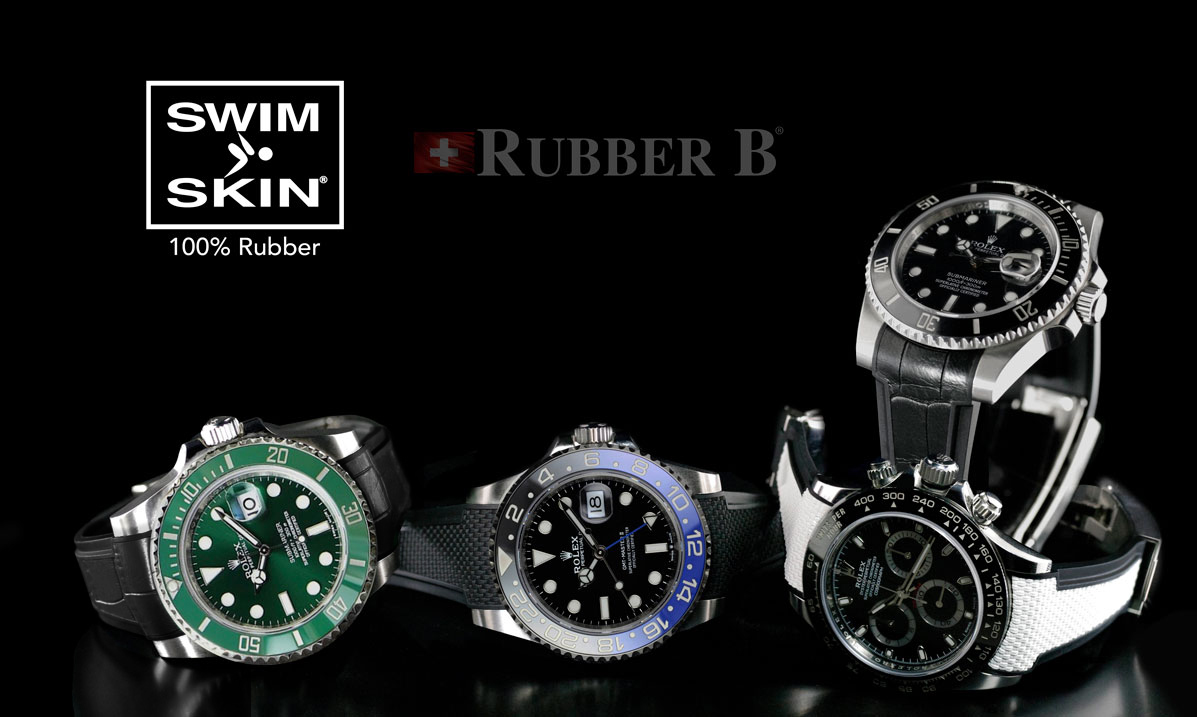
The key distinction is specificity.
A strap engineered for one Rolex Submariner reference cannot automatically be assumed to fit every Submariner simply because the watches appear similar.
Lug geometry, case dimensions, spring-bar positioning and clasp architecture can change from one generation to another.
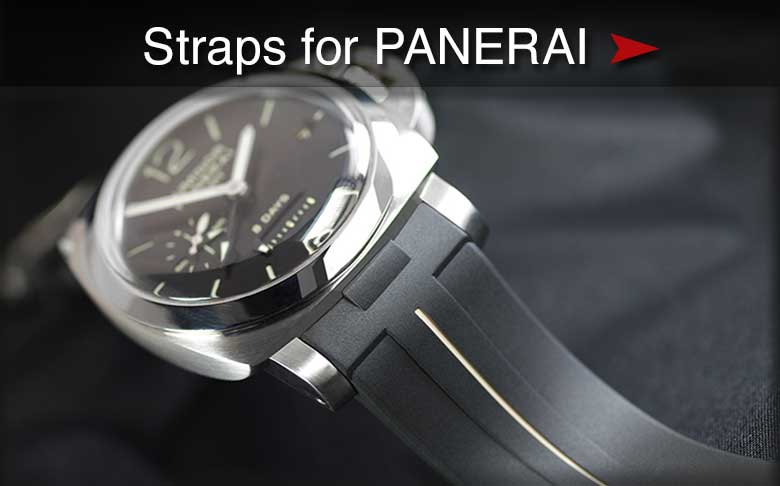
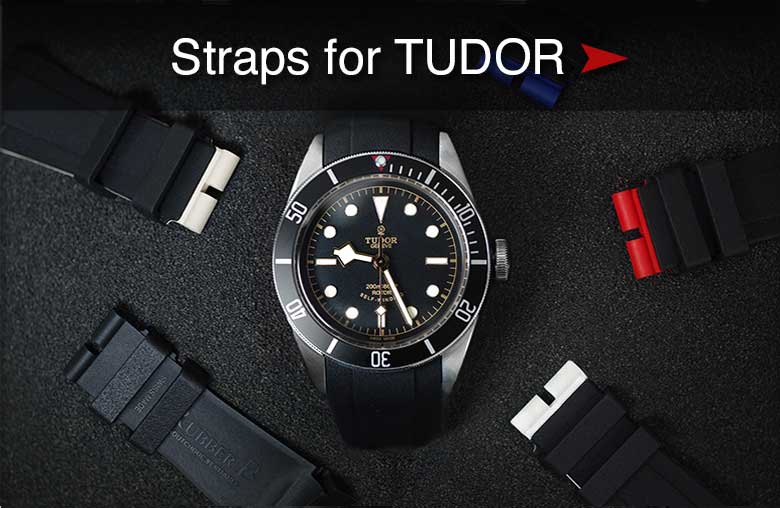
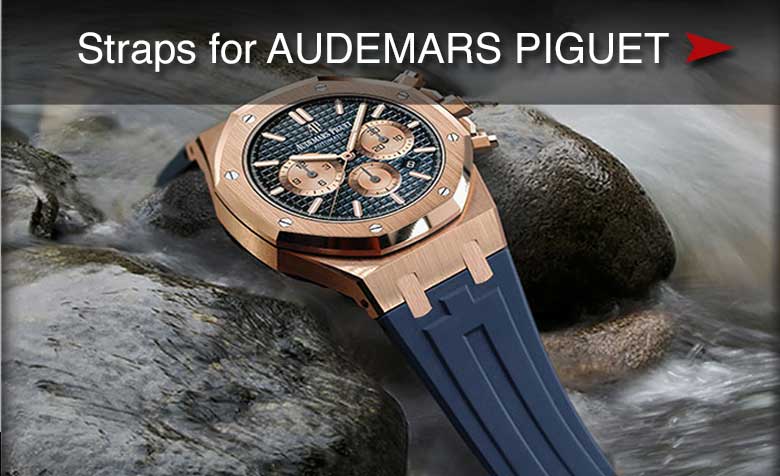
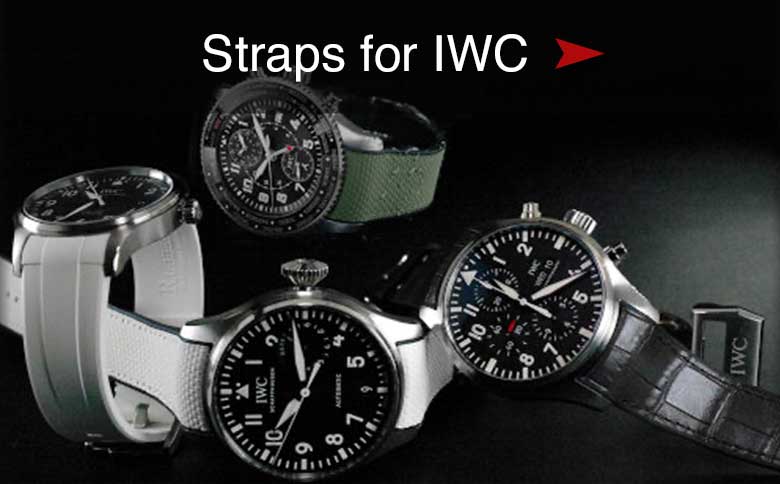
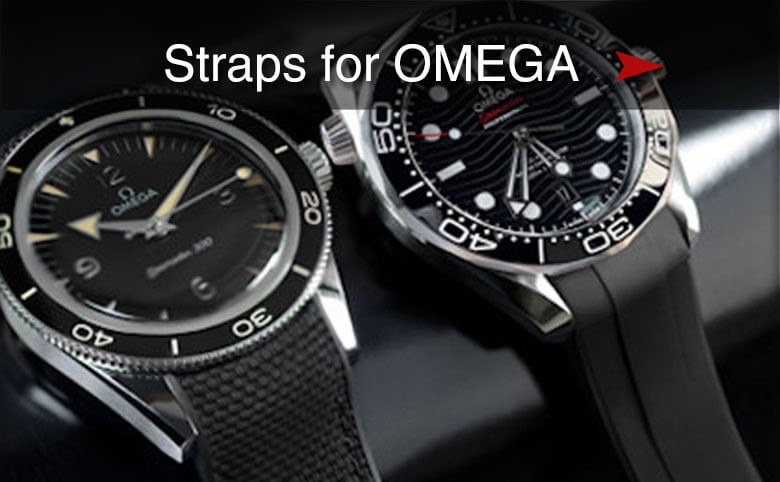
The same principle applies across watches such as the Rolex GMT-Master II, Daytona, Explorer, Sea-Dweller and Sky-Dweller, as well as models from Tudor, Audemars Piguet, Patek Philippe, Panerai, IWC, Omega, Zenith and other manufacturers for which Rubber B develops dedicated configurations.
That is why identifying the exact watch reference remains essential when selecting an integrated rubber strap.
Why Vulcanized Rubber Matters
Precise integration alone would be insufficient if the strap material could not retain the shape engineered into it.
Rubber B therefore uses Swiss-made vulcanized rubber throughout its principal rubber strap collections.
Vulcanization transforms natural rubber through controlled molecular cross-linking, producing a material with greater structural stability and resistance to deformation than untreated natural rubber.
For a luxury watch strap, those properties matter.
The strap repeatedly bends around the wrist. It encounters body heat, perspiration, water, sunlight and changes in environmental conditions. At the same time, areas close to the watch case and clasp must retain carefully controlled dimensions.
Rubber B describes its vulcanized rubber as resistant to environmental influences including UV exposure, ozone and aquatic conditions while remaining flexible for prolonged wear. The brand also specifies pure vulcanized-rubber construction without silicone blends on its principal rubber products.
This balance between flexibility around the wrist and stability at the connection points is fundamental to the Classic Series philosophy.
The material is not merely selected because it is rubber.
It is selected because its characteristics allow the engineered shape of the strap to perform as intended.
Engineering Around the Original Watch Clasp

One of the most distinctive features of numerous Rubber B Classic Series straps is their relationship with original manufacturer hardware.
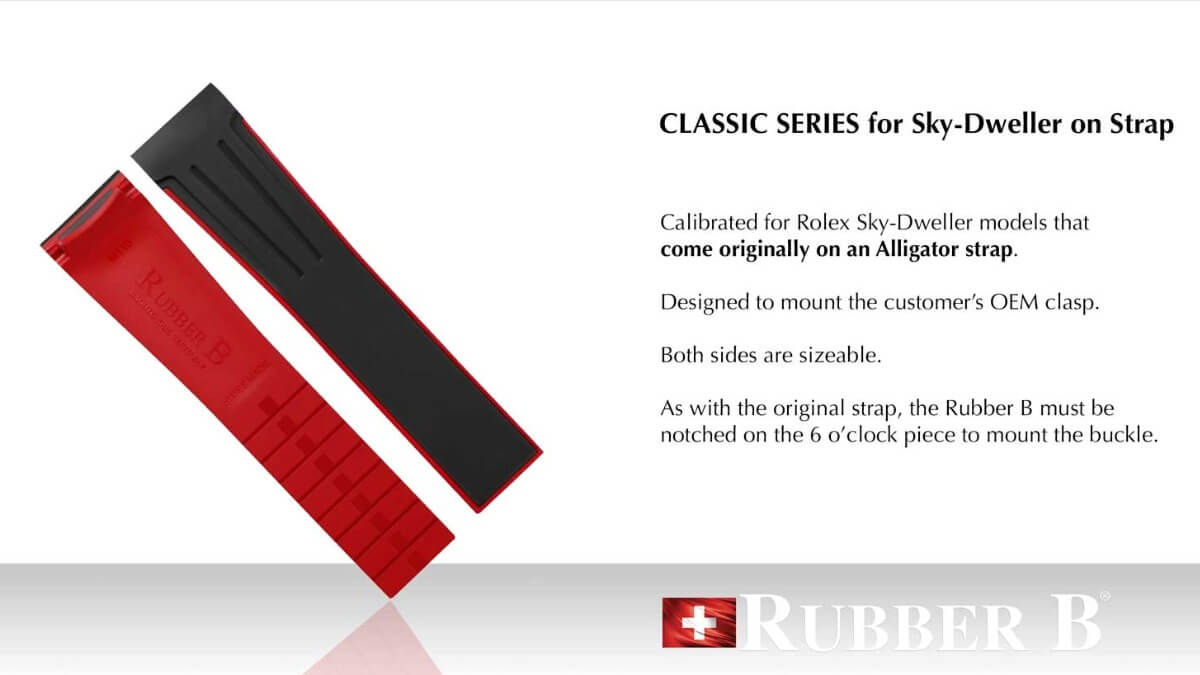
Instead of automatically replacing every component of the original bracelet system, certain straps are designed around compatible OEM deployant clasps.
This was present from the early stages of Rubber B’s development. The first Rolex-focused collections were designed to integrate with Rolex deployant Oyster clasps, according to Rubber B’s company history.
That architecture offers several advantages.
First, it allows the clasp to remain visually connected to the watch.
Second, it permits compatible clasp functionality to remain available.
Third, it requires Rubber B to engineer not only the connection at the watch case but also the connection at the opposite end of the strap.
For watches equipped with sophisticated adjustment systems such as the Rolex Glidelock clasp, the requirements become even more demanding.
Repeated micro-adjustment places particular forces on the portion of the strap connected to the clasp. For designated Glidelock-compatible products, Rubber B developed Strength Infusion Technology, incorporating carbon-fiber molecules into the vulcanized rubber during the molding process to increase resistance to vertical and lateral stresses while maintaining flexibility around the wrist.
It is an example of a recurring Rubber B principle:
Different parts of a strap perform different jobs.
The material around the wrist must remain comfortable and flexible, while strategically important connection points may require greater structural support.
VulChromatic®: Color Engineered Into the Strap
Once the architecture of the integrated rubber strap had been established, Rubber B expanded the possibilities of the material itself.
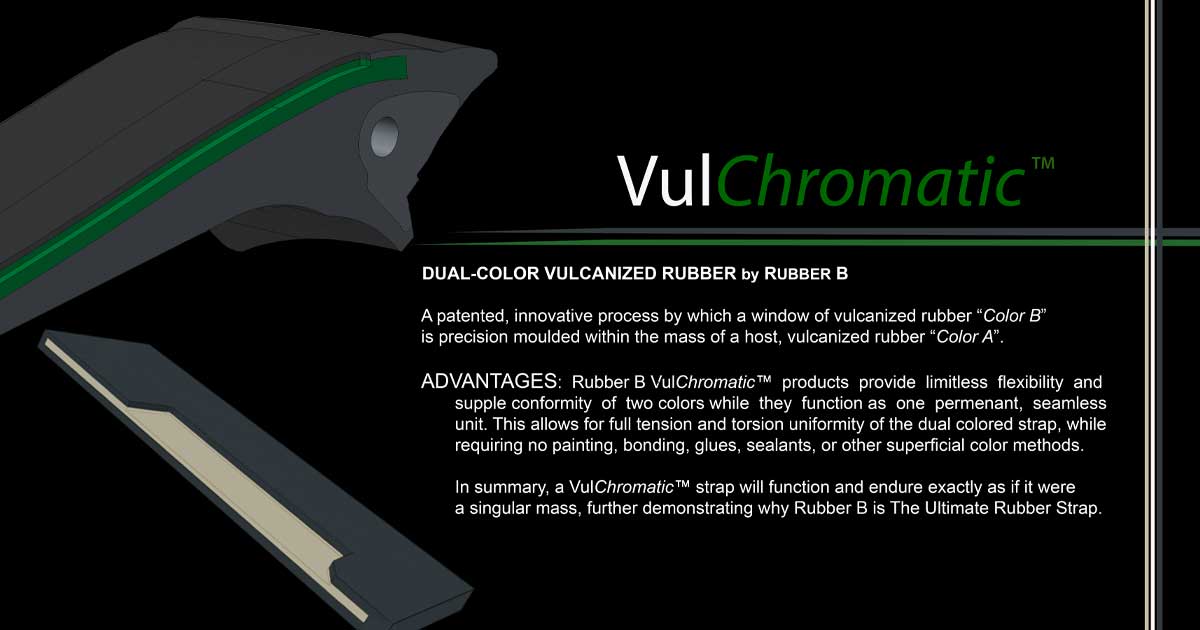
One example is VulChromatic® technology.
Creating a two-tone rubber strap may appear relatively simple from the outside. One option would be to apply paint, printing or another colored surface treatment to an existing strap.
Rubber B followed a different process.
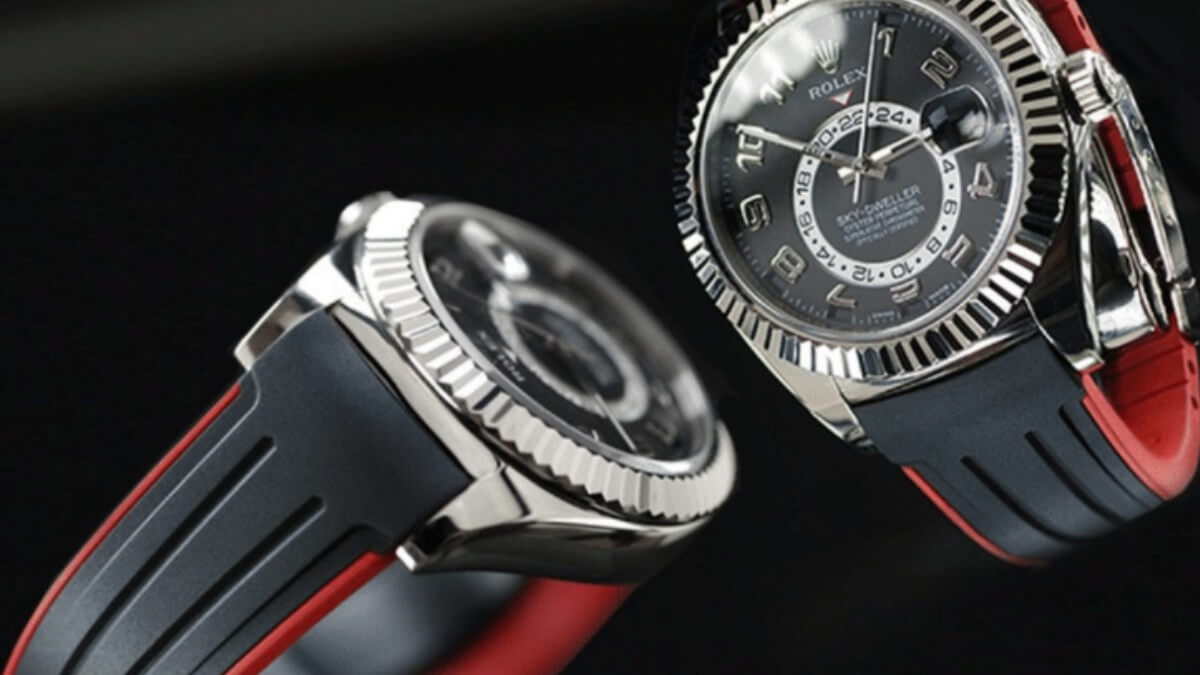
VulChromatic® straps use a molecular bonding process that fuses separate masses of colored rubber together. Rubber B states that the construction does not depend upon paint or glue to create the dual-color effect.
This matters because the color becomes part of the strap’s construction rather than merely a decorative treatment applied over its surface.
The technology also expanded the visual possibilities of the Classic Series.
A black exterior could be paired with a contrasting color visible along another surface of the strap, allowing colors associated with a bezel, dial, seconds hand or other detail of the watch to be referenced without overwhelming the design.
For luxury sports watches, where a single accent color can define the personality of a reference, this provided a more controlled approach to customization.
SwimSkin®: When Rubber No Longer Has to Look Like Rubber
Another important development came from reconsidering the surface appearance of vulcanized rubber.
Traditional luxury straps are frequently associated with materials such as alligator leather or woven textiles. These materials offer distinctive visual character, but natural leather and many traditional fabrics introduce limitations around prolonged exposure to water.
Rubber B’s SwimSkin® concept approaches the problem from the opposite direction.
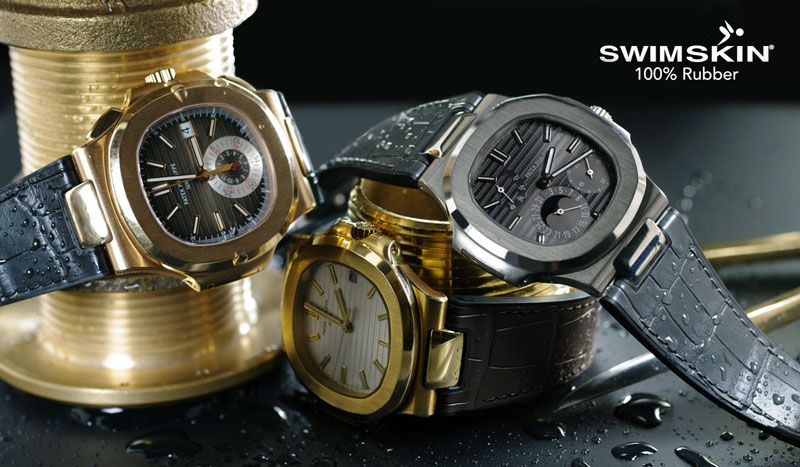
Instead of making a moisture-sensitive material more resistant to water, SwimSkin® uses rubber engineered to visually reproduce the texture associated with materials such as alligator hide or ballistic textile.
Underneath the texture, however, the strap remains vulcanized rubber.
Rubber B’s SwimSkin® product specifications describe these straps as 100% rubber and suitable for aquatic use, including configurations designed to replicate the appearance of alligator or ballistic material.
This creates an unusual intersection between traditional luxury aesthetics and sports-watch functionality.
A collector can achieve the visual character normally associated with a more formal strap while retaining a material designed around water exposure and active use.
The innovation demonstrates how Rubber B’s development progressed beyond solving the problem of case integration.
The next question became:
What else could vulcanized rubber be engineered to do?
From Model-Specific Integration to the Dream Strap® and MeshMatic®
Rubber B’s earliest identity was closely associated with model-specific integration.
That remains central to the brand, but not every luxury watch requires the same solution.
Many traditional watches use conventional straight-lug architecture. For these watches, attempting to reproduce a model-specific integrated profile would not necessarily provide an advantage.
The challenge becomes different.
Instead of solving the relationship between a complicated watch case and a curved strap end, the engineering can focus on adjustment, ergonomics and versatility.
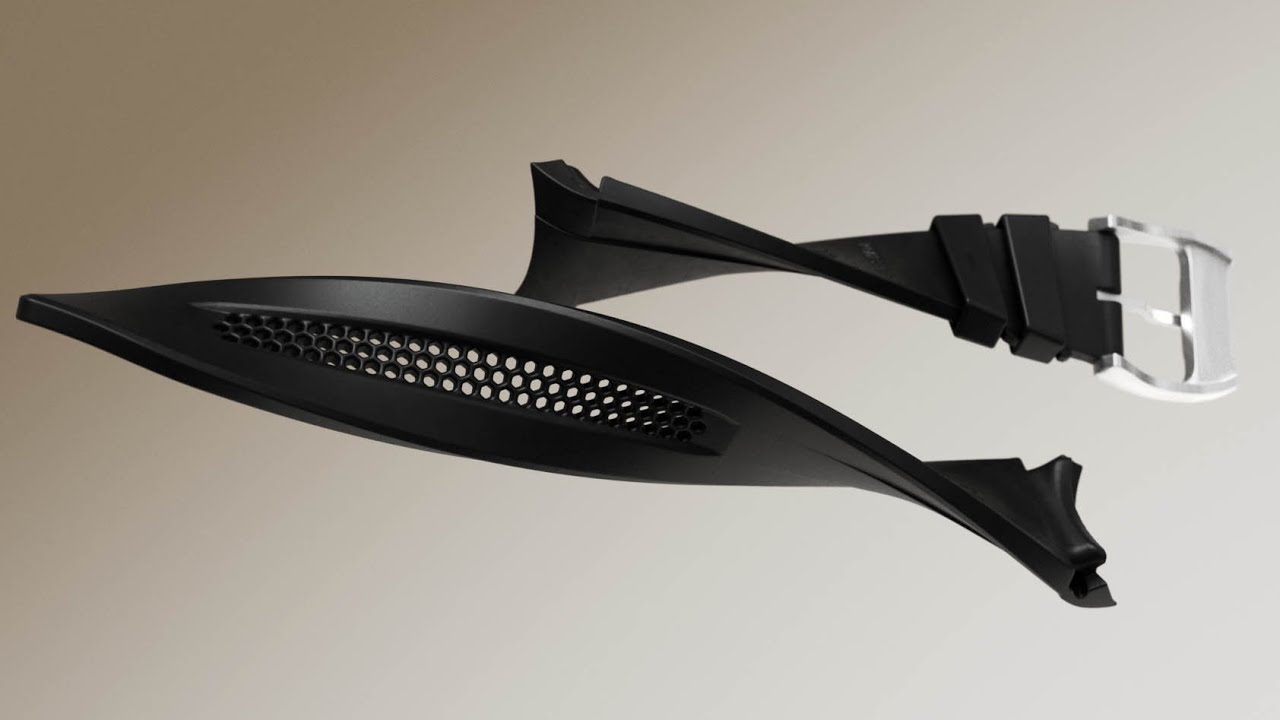
The Rubber B Dream Strap® represents this evolution.
Universal Dream Strap configurations are available for conventional lug widths and are manufactured in Switzerland from vulcanized rubber. They incorporate MeshMatic® technology, a micro-adjustment architecture designed to provide significantly finer control over wrist fit than conventional fixed-position strap sizing.
MeshMatic® technology has also been incorporated into Dream Strap configurations for selected model-specific watches, demonstrating that universal and integrated engineering no longer have to exist as completely separate design philosophies.
The objective remains consistent:
Create a strap around the way the watch is actually worn.
Why Precise Integration Matters on a Luxury Watch
Luxury-watch collectors often concentrate on materials, dial configurations, movements and complications.
Strap geometry can receive considerably less attention.
Yet the strap determines nearly every physical interaction between the owner and the watch.
Proportion
A strap that is too thin, too thick or incorrectly tapered can alter the visual proportions of a watch.
This is particularly noticeable on substantial sports watches such as the Rolex Submariner, Sea-Dweller or Audemars Piguet Royal Oak.
The strap must visually support the case rather than simply fit between its lugs.
Case Geometry
Modern watch cases rarely consist of simple vertical surfaces.
Lugs curve.
Cases taper.
Spring bars sit at different depths and distances from the case.
Model-specific integration allows these characteristics to become part of the strap design.
Wrist Balance
A heavy watch head can move noticeably if the strap does not properly distribute its mass around the wrist.
Strap shape, taper, clasp position and sizing all influence how securely and naturally the watch is carried.
Clasp Function
On watches using sophisticated deployant systems, the clasp is itself a piece of precision engineering.
Designing a strap around compatible original clasp hardware allows the strap system to preserve more of the original watch’s mechanical character.
Material Stability
The closer the tolerances become around the case and clasp, the more important material stability becomes.
A precisely engineered strap must continue to hold its intended dimensions while repeatedly flexing around the wrist.
This is one reason vulcanized rubber and structural reinforcement technologies play such an important role in Rubber B’s design philosophy.
A Different Approach to Watch Customization
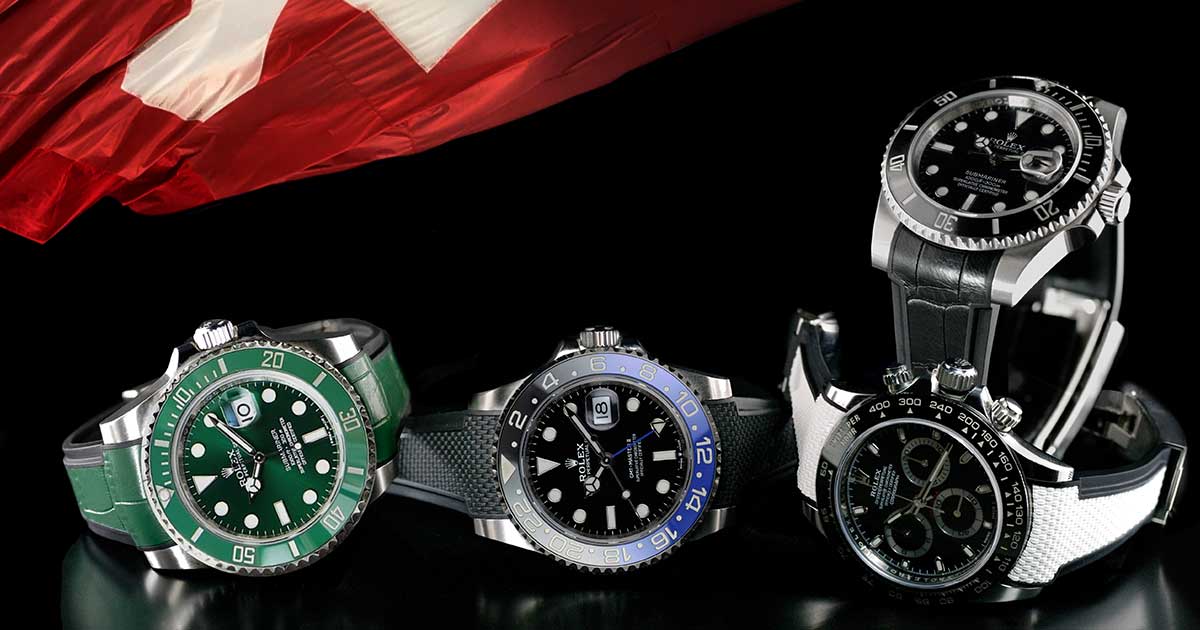
Changing a strap can dramatically alter the personality of a watch without altering the watch itself.
A black rubber strap can give a precious-metal Daytona a more restrained character.
A complementary color can reference the bezel of a GMT-Master II.
A SwimSkin® texture can introduce the visual character of alligator to a sports watch without introducing the same concern around water exposure.
An integrated strap can also make a familiar watch feel markedly different on the wrist while allowing the original bracelet to be preserved separately.
For collectors, this makes the strap one of the most reversible forms of watch customization.
The watch case, dial, bezel and movement remain unchanged.
The relationship between the watch and the wrist changes completely.
The Legacy of the Rubber B Classic Series
The importance of the Rubber B Classic Series extends beyond any individual color, watch reference or clasp configuration.
Its underlying principle helped define Rubber B’s approach to luxury watch straps:
begin with the watch itself.
The watch case determines the geometry.
The clasp determines another part of the architecture.
The expected environment influences the material.
The movement of the wrist affects ergonomics.
Only after those requirements have been considered does the strap become a finished product.
That philosophy can now be seen across a much broader range of Rubber B technologies.
Blocked Integration™ addresses the relationship between strap and case.
Strength Infusion Technology reinforces demanding clasp interfaces.
VulChromatic® expands what is possible with color.
SwimSkin® transforms the visual language of rubber.
MeshMatic® addresses precise wrist adjustment.
Different technologies solve different problems, yet they share a common premise: a luxury watch strap should be engineered with the same respect for precision that collectors expect from the watch itself.
Rubber B Classic Series Frequently Asked Questions
What is the Rubber B Classic Series?
The Rubber B Classic Series is a collection of Swiss-made vulcanized rubber straps engineered for specific luxury watches. Depending on the model, Classic Series straps can incorporate Blocked Integration™ and may be designed to work with compatible original manufacturer deployant clasps.
What is Blocked Integration™?
Blocked Integration™ is Rubber B’s model-specific strap engineering system. Certain straps incorporate calibrated solid inserts at the watch connection to create a stable, flush relationship between the rubber strap and the intended watch case.
Are Rubber B straps made in Switzerland?
Yes. Rubber B states that its straps are manufactured and hand-finished in Switzerland. The company specializes in vulcanized-rubber straps developed for luxury watches and specific watch-case architectures.
What is the difference between the Classic Series and a universal rubber strap?
A universal strap is generally selected primarily according to lug width and can be compatible with numerous watches. A model-specific Classic Series strap is engineered around the geometry and attachment system of a particular watch or family of compatible references.
Can a Rubber B strap use the original Rolex clasp?
Certain Rubber B Classic Series and other model-specific configurations are designed for compatible original Rolex deployant clasps. Compatibility depends upon the exact Rolex reference and strap configuration, so the watch model should always be verified before installation.
What is VulChromatic®?
VulChromatic® is Rubber B’s dual-color rubber technology. Separate colored rubber masses are molecularly bonded together without relying upon paints or glues to produce the contrasting-color construction.
What is SwimSkin®?
SwimSkin® is Rubber B technology that creates vulcanized-rubber straps with surface textures inspired by traditional materials such as alligator hide or ballistic textile. Despite their appearance, the straps remain rubber and are designed for aquatic use.
What is MeshMatic® technology?
MeshMatic® is a micro-adjustment system incorporated into Rubber B Dream Strap® designs. It allows the wearer to make finer adjustments to wrist fit than conventional fixed sizing positions.
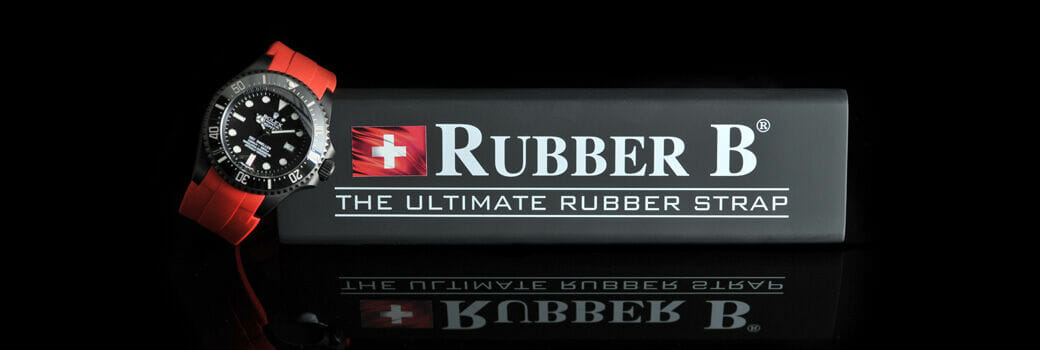
The Strap as an Extension of the Watch
Since the beginning of Rubber B, the central engineering question has remained remarkably consistent.
How should a rubber strap interact with a fine timepiece?
The answer developed through the Classic Series was not to treat the strap as a generic accessory.
It was to study the geometry of the watch, the architecture of the lugs, the characteristics of the clasp, the properties of the material and the requirements of the wearer—and engineer the strap around them.
That principle ultimately became the foundation for many of Rubber B’s later innovations.
The legacy of the Rubber B Classic Series is therefore larger than the creation of an alternative to a metal bracelet.
It established the idea that a luxury rubber strap should not simply attach to a watch. It should be engineered around it.
Rubber B is an independent company and is not affiliated with Rolex SA, Audemars Piguet Holding SA, Patek Philippe SA, Tudorwatch SA, IWC International Watch Co., or other watch manufacturers referenced in this article. All trademarks, watch names and related intellectual property belong to their respective owners.
Follow Us on Instagram