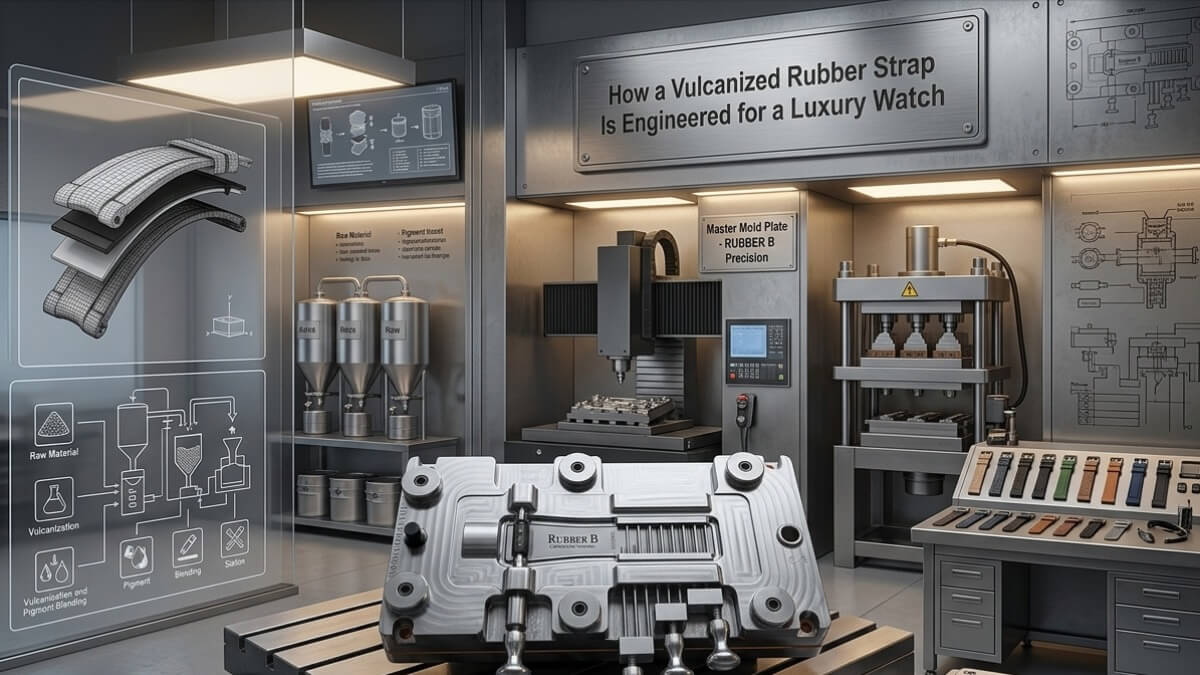
A luxury watch strap has a demanding role.
It must remain comfortable against the wrist while supporting the weight of the watch. It is repeatedly bent, stretched and exposed to heat, moisture, perspiration, sunlight and the environment. At the same time, a strap fitted to a finely engineered Swiss timepiece must maintain the appearance and precision expected from the watch itself.
For Rubber B, the material at the center of that equation is vulcanized rubber.
But what is vulcanized rubber, how is it different from raw rubber, silicone and other elastomers, and why is it particularly well suited to a luxury watch strap?
Vulcanized rubber is rubber that has undergone a controlled curing process in which polymer chains are chemically cross-linked, creating a more stable elastic network. This transformation improves the material’s ability to recover from deformation and allows its properties to be engineered for demanding applications.
Rubber B applies this material technology specifically to luxury watch straps, combining Swiss-Made vulcanized rubber with reference-specific engineering, proprietary technologies and precise integration with compatible timepieces.
What Is Vulcanized Rubber?
Rubber begins as a flexible polymeric material.
In its uncured state, however, rubber does not possess all of the mechanical stability required for demanding finished products.
Vulcanization changes that.
During vulcanization, chemical connections known as cross-links are created between neighboring polymer chains. These links restrict the chains from moving independently while still allowing the material to stretch and recover.
The result is a three-dimensional elastic network.
In simple terms:
Raw rubber contains long molecular chains that can move relatively freely. Vulcanization connects those chains at controlled points, producing a material with greater stability, elastic recovery and resistance to permanent deformation.
This transformation is one of the reasons vulcanized rubber has become such an important engineering material.
It is used in applications ranging from seals and technical components to footwear, automotive products and precision consumer goods.
For a luxury watch strap, the same underlying principle is especially valuable: the material must flex thousands of times while maintaining its intended form.
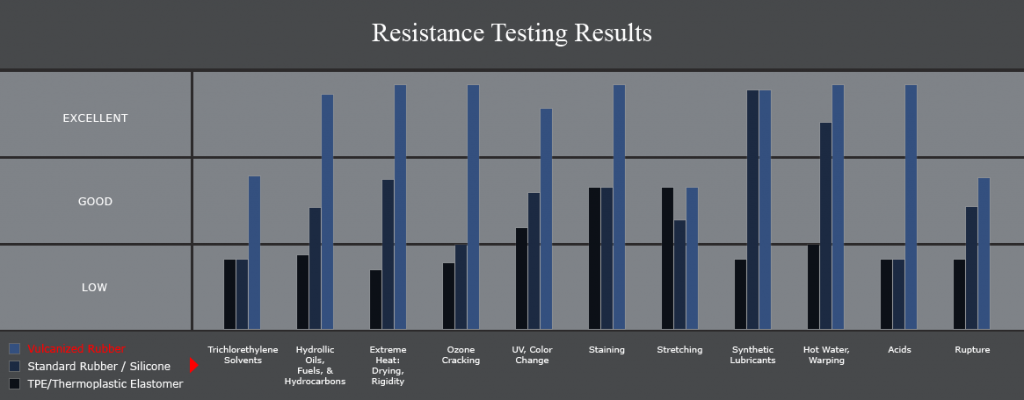
How Does Vulcanization Work?
The chemistry of vulcanization is more complex than simply “heating rubber.”
In traditional sulfur vulcanization of natural rubber and other compatible elastomers, a curing system creates sulfur-containing cross-links between sections of neighboring polymer chains.
Before curing, the molecular chains have considerably more freedom to move relative to one another.
After cross-linking, they become part of a connected network.
An easy way to visualize the process is to imagine a collection of long individual threads.
If the threads are completely independent, they can slide past one another easily.
Vulcanization effectively creates carefully controlled connections between them.
The material can still flex and deform, but the interconnected molecular network encourages it to return toward its original form.
Modern rubber engineering can use different elastomers, curing systems, additives, temperatures and processing methods depending on the desired final characteristics.
For that reason, vulcanized rubber is not one universal formula.
It is a category of cured elastomeric materials whose final properties depend heavily on formulation and manufacturing.
This distinction is particularly important when comparing watch straps.
Simply describing a strap as “rubber” does not reveal its material quality, formulation, curing process or engineering.
Why Was Vulcanization So Important?
The development of vulcanization transformed rubber from an interesting natural material into a practical engineering material.
Charles Goodyear’s experiments with sulfur and rubber in the nineteenth century are closely associated with the development of the process. The breakthrough demonstrated that rubber’s behavior could be substantially altered through controlled curing.
The importance of the discovery extended far beyond a single product.
Vulcanization helped make rubber practical for applications in which dimensional stability, elasticity and repeated mechanical movement were required.
Modern vulcanization technology has advanced considerably since those early experiments, but the fundamental concept remains: cross-linking the polymer structure changes how rubber behaves.
Raw Rubber vs. Vulcanized Rubber
The distinction can be summarized simply:
| Characteristic | Unvulcanized Rubber | Vulcanized Rubber |
| Polymer structure | Chains have greater freedom of movement | Chains are connected through cross-links |
| Dimensional stability | Lower | Greater |
| Elastic recovery | More limited | Improved |
| Permanent deformation | More susceptible | Better controlled |
| Mechanical properties | Limited for demanding applications | Can be engineered for specific uses |
| Practical applications | Restricted | Widely used in engineered products |
The exact properties of any finished rubber compound still depend on its formulation.
Vulcanization is therefore not a guarantee that every vulcanized-rubber product will perform identically.
The material, curing system, mold design, manufacturing tolerances and quality control all matter.
That is an important distinction when evaluating a rubber watch strap.
Why Use Vulcanized Rubber for a Watch Strap?
A watch strap presents several unusual engineering challenges simultaneously.
It must be:
- Flexible enough to curve comfortably around the wrist
- Stable enough to support a substantial watch case
- Capable of repeated flexing
- Suitable for contact with moisture and perspiration
- Resistant to normal environmental exposure
- Precisely manufactured around spring bars, clasps and watch cases
- Comfortable during extended wear
- Visually appropriate for a luxury timepiece
A properly engineered vulcanized-rubber compound can balance these requirements particularly well.
For Rubber B, however, material selection is only the beginning.
The rubber must then be shaped, calibrated and integrated specifically for the watch for which the strap was designed.
Elasticity and Shape Recovery
A watch strap constantly changes shape.
It bends when the watch is put on. It follows the curvature of the wrist. It flexes when the wrist moves and experiences localized stress around adjustment holes, attachment points and clasp areas.
The cross-linked structure created during vulcanization allows rubber to deform elastically while encouraging it to recover toward its designed form.
This makes vulcanized rubber especially appropriate for products that experience repeated movement.
In a luxury watch strap, controlled flexibility is important.
A strap that is excessively rigid may be uncomfortable.
A material that is excessively soft or dimensionally unstable may not properly support a heavy watch.
The objective is not maximum softness or maximum hardness.
It is balance.
Resistance to Water and Daily Exposure
One of the principal advantages of a high-quality rubber watch strap is its suitability for environments in which traditional leather would require greater care.
A rubber strap can be particularly practical for:
- Swimming
- Boating
- Exercise
- Warm climates
- Humid conditions
- Travel
- Everyday wear
- Exposure to perspiration
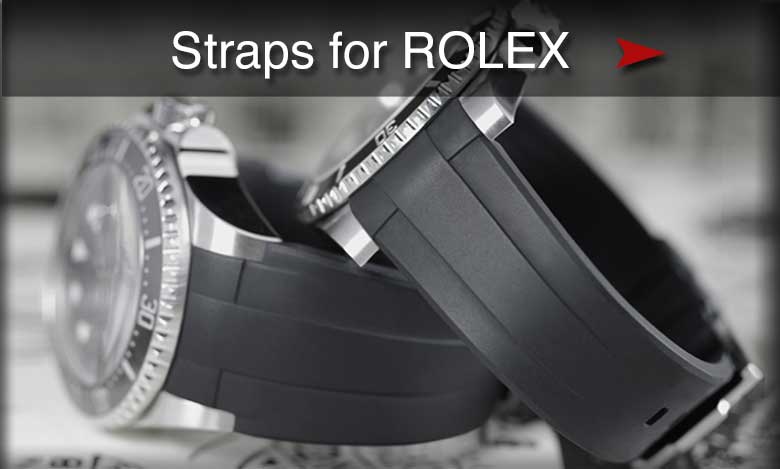
This is particularly relevant to sport watches such as the Rolex Submariner, Sea-Dweller, GMT-Master II, Tudor Pelagos and other watches designed around active use.
The strap material must complement that functionality rather than restrict it.
Rubber B’s vulcanized rubber straps are engineered for exposure to demanding environments, including aquatic conditions, while maintaining the appearance expected from a luxury accessory.
UV and Ozone Exposure
Rubber materials can be affected by environmental factors such as ultraviolet radiation, atmospheric ozone, temperature and oxidation.
This is why rubber formulation is important.
High-quality engineered rubber compounds can incorporate material chemistry designed around the conditions the finished product is expected to encounter.
For a watch strap, this matters because the product spends considerable time exposed directly to sunlight and air.
Rubber B specifically engineers its vulcanized-rubber straps for continued use in environments involving UV exposure, water and normal outdoor conditions.
The objective is a strap intended to be worn rather than protected from everyday life.
Comfort Against the Wrist
Durability alone does not make a successful watch strap.
The material must also be comfortable.
Vulcanized rubber can combine flexibility with structural support, allowing a properly engineered strap to conform naturally around the wrist.
This characteristic becomes particularly important with larger luxury sport watches.
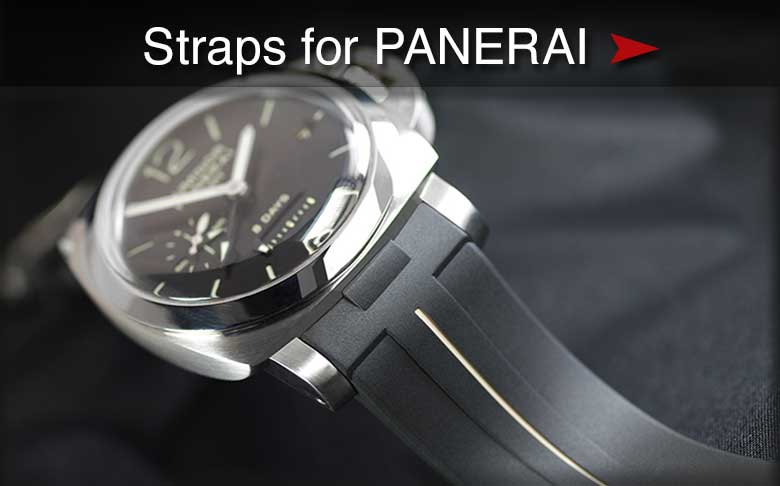
A substantial Rolex, Tudor, Panerai, Audemars Piguet or similar timepiece places considerably more mass on the wrist than a lightweight dress watch.
The strap therefore contributes directly to how the watch is positioned and supported.
Rubber B engineers strap curvature, thickness and dimensions together rather than treating the material as a generic strip of rubber fitted between two lugs.
Is Vulcanized Rubber the Same as Silicone?
No.
Silicone and the vulcanized rubber used by Rubber B should not be treated as interchangeable materials.
Silicone straps are extremely common throughout the watch market. They can be soft, inexpensive to manufacture and available in an extensive range of colors.
However, the term silicone identifies a particular family of polymeric materials.
Vulcanization, by contrast, describes a curing or cross-linking process.
This is an important technical distinction.
In everyday watch terminology, consumers often use “rubber,” “silicone” and other material names interchangeably. From a materials perspective, they are not identical.
Rubber B does not manufacture its luxury watch straps as conventional silicone straps.
Rubber B describes its strap construction as 100% vulcanized rubber, manufactured in Switzerland and developed specifically for luxury-watch applications.
Is Vulcanized Rubber the Same as FKM?
Not exactly—and this distinction is frequently misunderstood.
FKM refers to a family of fluorocarbon elastomers.
Vulcanization refers broadly to the curing or cross-linking of rubber.
Therefore, from a materials-science perspective, “FKM” and “vulcanized rubber” are not perfect opposites. Different elastomer families can undergo curing or cross-linking processes.
Within the watch-strap market, however, the terms are often used as shorthand for different product categories and manufacturing approaches.
Rubber B’s material should therefore be identified according to what the company actually manufactures: Swiss-Made, pure vulcanized-rubber watch straps produced through Rubber B’s proprietary manufacturing specifications.
For a detailed comparison of the commercial strap categories, see FKM vs. Vulcanized Rubber Watch Straps: What’s the Difference?
What Makes Rubber B’s Vulcanized Rubber Different?
The word “rubber” alone does not determine the quality of a watch strap.
Just as stainless steel can be manufactured to different specifications and leather can vary dramatically according to tanning and finishing, rubber products can differ according to formulation, curing, molding, tolerances and quality control.
Rubber B’s approach combines several elements.
1. Swiss-Made Manufacturing
Rubber B straps are manufactured in Switzerland by professionals operating within the Swiss luxury-watch industry.
This is central to the brand’s identity.
The strap is not positioned as an inexpensive universal accessory that happens to fit between the lugs of a luxury watch.
It is developed according to the standards expected from a precision component intended for a high-value timepiece.
2. 100% Vulcanized-Rubber Construction
Rubber B describes its rubber straps as being manufactured from 100% vulcanized rubber.
This should not be interpreted to mean that an engineered rubber formulation contains no curing ingredients—the chemistry of producing vulcanized rubber inherently requires a controlled formulation.
Instead, the distinction refers to the finished strap body being engineered as vulcanized rubber rather than relying on plastic blends or decorative surface coatings to imitate the appearance of premium rubber.
Rubber B states that its rubber straps contain no plastic blends or surface coatings.
This contributes to the consistent material character of the strap from its exterior through its construction.
3. Reference-Specific Engineering
Material alone does not create an integrated watch strap.
The dimensions of the case, lugs, spring bars, bracelet interface and clasp must all be considered.
Rubber B develops many of its straps around specific luxury-watch references.
Rather than leaving a generic gap between the strap and case, compatible integrated configurations are shaped around the architecture of the intended watch.
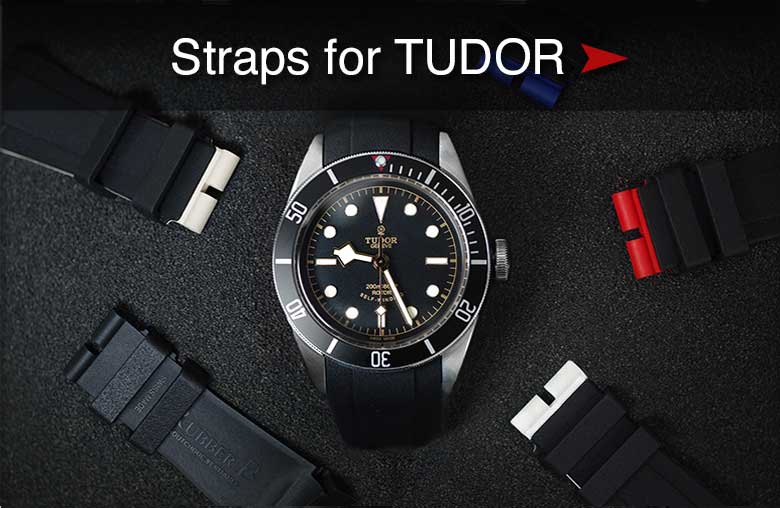
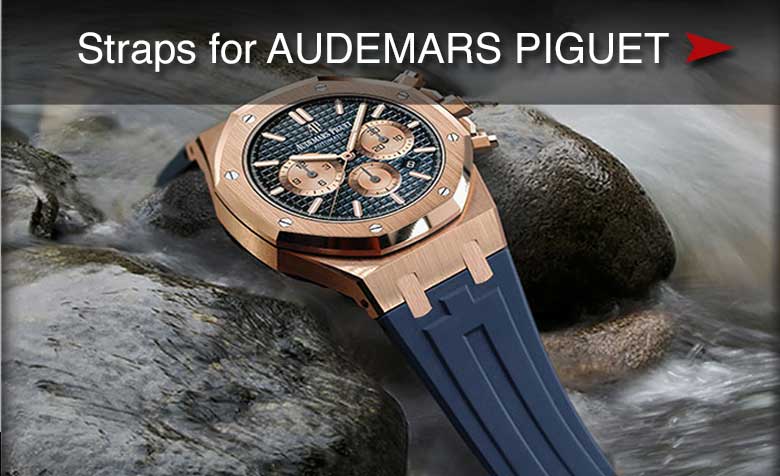
This approach can be seen across Rubber B collections engineered for watches from Rolex, Tudor, Patek Philippe, Audemars Piguet, Panerai, IWC, Breitling, Omega and other manufacturers.
Compatibility should always be confirmed according to the exact watch reference.
4. Blocked Integration™
On compatible models, Rubber B applies its proprietary Blocked Integration™ engineering.
Solid inserts are incorporated into the mounting area of selected integrated straps, helping create a calibrated and stable interface between the strap, spring bar and watch case.
This is separate from the vulcanized-rubber material itself.
The distinction is important:
Vulcanized rubber describes the material platform.
Blocked Integration™ describes the engineering of the attachment interface on compatible products.
Both can exist within the same strap while performing different functions.
What Is VulChromatic®?
Vulcanized rubber also provides the foundation for another Rubber B innovation: VulChromatic®.
VulChromatic® is Rubber B’s patented dual-color technology.
Rather than applying a contrasting color through paint or attaching it as a decorative surface layer, separate colored rubber masses are permanently incorporated into the strap construction.
The result makes the secondary color part of the vulcanized-rubber strap itself.
This is an important example of the relationship between Rubber B’s different technologies.
Vulcanized rubber is the underlying material.
VulChromatic® is a proprietary dual-color technology used on selected vulcanized-rubber straps.
For the complete explanation, see What Is VulChromatic®? Rubber B’s Patented Dual-Color Rubber Technology.
Vulcanized Rubber and SwimSkin®
Rubber B has also used vulcanized rubber to challenge the traditional appearance of a rubber watch strap.
SwimSkin® uses specialized surface textures to create the visual character of materials such as alligator or ballistic fabric while maintaining an all-rubber construction.
This allows a strap to offer a more traditional or textile-inspired appearance without requiring the exterior material to behave like leather or fabric when exposed to water.
The concept demonstrates an important principle behind Rubber B’s material development:
Vulcanized rubber does not have to look utilitarian.
Through tooling, texture, geometry and finishing, it can become part of the visual language of a luxury watch.
Vulcanized Rubber With Tang Buckles and Deployant Clasps
The rubber material does not determine which closure system must be used.
Depending on the exact watch and Rubber B Series, a vulcanized-rubber strap may be engineered for:
- A Rubber B tang buckle
- A compatible original watchmaker deployant clasp
- A factory clasp with adjustment functionality
- Another reference-specific closure
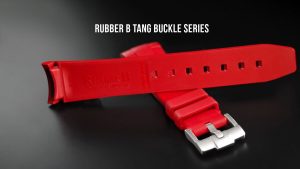
For example, certain Rubber B Rolex configurations allow the owner to retain the original Rolex clasp, while the Tang Buckle Series uses a dedicated Rubber B tang buckle.
This allows collectors to choose between different closure philosophies while retaining the advantages of a Swiss-Made vulcanized-rubber strap.
See Tang Buckle vs. Deployant Clasp: Pros, Cons & Which Is Right for Your Watch? for a complete comparison.
Why Vulcanized Rubber Works Particularly Well With Sport Watches
Luxury sport watches were designed to function beyond formal environments.
Dive watches, travel watches and professional chronographs can be exposed to conditions very different from those encountered by a traditional dress watch.
Consider the requirements of watches such as:
- Rolex Submariner
- Rolex Sea-Dweller
- Rolex GMT-Master II
- Rolex Daytona
- Tudor Pelagos
- Tudor Black Bay
- Panerai Luminor
- Audemars Piguet Royal Oak
- Patek Philippe Aquanaut
Each combines luxury watchmaking with some degree of sporting or technical identity.
A vulcanized-rubber strap complements this character by providing a material that can transition between daily use, travel and active environments.
At the same time, precise integration allows the rubber strap to remain visually consistent with the quality of the watch.
That combination—technical performance with carefully controlled design—is what makes vulcanized rubber particularly relevant to modern luxury watchmaking.
How Should a Vulcanized Rubber Watch Strap Be Cleaned?
Routine care is relatively simple.
For normal wear, a Rubber B vulcanized-rubber strap can generally be cleaned using fresh water and mild soap, followed by a thorough rinse and drying with a soft cloth.
After exposure to saltwater, rinsing the strap with fresh water is advisable.
Owners should avoid unnecessary exposure to aggressive chemicals, solvents or abrasive cleaning products.
A luxury watch should also be cleaned according to the watch manufacturer’s recommendations, particularly around the case, crown and water-resistance specifications.
Regular cleaning helps remove perspiration, salt, sunscreen, dust and other substances that can accumulate during everyday wear.
Does Vulcanized Rubber Last Forever?
No watch strap should be considered permanent.
A strap is a wearable component subjected to movement, environmental exposure and mechanical stress.
Its lifespan will depend on variables including:
- Frequency of wear
- Wrist fit
- Environmental exposure
- Contact with chemicals
- Cleaning habits
- Storage
- Strap configuration
- Repeated stress around attachment and adjustment points
High-quality vulcanized rubber is engineered for long-term use, but it should still be inspected periodically.
Any strap showing significant damage, tearing or compromised attachment points should be replaced.
This is particularly important when the strap is supporting a valuable luxury timepiece.
Frequently Asked Questions About Vulcanized Rubber Watch Straps
What is vulcanized rubber?
Vulcanized rubber is rubber that has undergone a curing process that creates chemical cross-links between polymer chains. These connections form a more stable elastic network, allowing the material’s strength, elasticity, dimensional stability and recovery characteristics to be engineered for practical use.
What does vulcanization do to rubber?
Vulcanization restricts excessive movement between polymer chains by chemically connecting them. This transforms uncured rubber into a more stable elastic material capable of recovering more effectively after deformation.
Is vulcanized rubber natural rubber?
Vulcanization is a process rather than a single raw material.
Natural rubber can be vulcanized, and sulfur vulcanization of natural rubber is the classic historical example. Other elastomers can also be cured or cross-linked using different systems.
Rubber B describes its watch straps as being manufactured from pure vulcanized rubber according to its proprietary Swiss manufacturing specifications.
Is vulcanized rubber waterproof?
Rubber itself does not absorb water in the same way that porous natural materials such as untreated leather can, making vulcanized-rubber straps particularly suitable for aquatic environments.
However, a rubber strap does not determine whether the watch itself is waterproof or water-resistant.
The water resistance of the timepiece is determined by the watch manufacturer and the condition of its case, seals, crown and related components.
Is vulcanized rubber good for watch straps?
Yes. Properly engineered vulcanized rubber can provide an excellent combination of flexibility, elastic recovery, water suitability, and structural stability for watch-strap applications.
The performance of the finished strap still depends on the formulation, manufacturing quality, dimensions, and attachment engineering.
Is vulcanized rubber better than silicone for a watch strap?
They are different material systems.
Silicone can offer softness, flexibility, and low manufacturing cost. Premium vulcanized-rubber formulations can be engineered around different priorities, including structural stability, surface character, and long-term mechanical performance.
The quality of the finished strap should be evaluated rather than assuming that every product within one material category is identical.
Is FKM the same as vulcanized rubber?
FKM identifies a family of fluorocarbon elastomers, while vulcanization refers to a curing or cross-linking process.
For this reason, the terms are not technically direct opposites, even though the watch-strap market frequently uses “FKM strap” and “vulcanized-rubber strap” to describe different commercial product categories.
Are Rubber B straps made from silicone?
Rubber B identifies its rubber watch straps as Swiss-Made, 100% vulcanized rubber rather than conventional silicone straps.
Are Rubber B watch straps Swiss-Made?
Yes. Rubber B’s straps are manufactured in Switzerland and bear the Swiss-Made designation according to the company’s manufacturing standards.
Does Rubber B use coatings on its rubber straps?
Rubber B states that its pure vulcanized-rubber straps are not dependent on plastic blends or decorative surface coatings.
Specialized designs such as VulChromatic® instead incorporate contrasting colored rubber directly into the strap construction.
Can vulcanized rubber be used in saltwater?
Rubber B’s vulcanized-rubber straps are designed for active use, including aquatic environments.
After saltwater exposure, rinsing the strap with fresh water remains good practice.
Always remember that the strap’s suitability for water does not change the manufacturer’s water-resistance rating of the watch itself.
Vulcanized Rubber: The Material Behind Rubber B
The difference between a standard rubber strap and a luxury rubber watch strap begins long before the strap reaches the wrist.
It begins with material engineering.
Vulcanization transforms rubber by creating a controlled cross-linked molecular network. That fundamental process provides the stability and elastic behavior required for countless demanding technical applications.
Rubber B applies that principle specifically to luxury watches.
The company’s straps are manufactured in Switzerland from vulcanized rubber and then engineered around the dimensions, mounting architecture and closure requirements of compatible timepieces.
From there, technologies such as Blocked Integration™, VulChromatic® and SwimSkin® demonstrate what can be achieved when rubber is treated not as an inexpensive substitute for a bracelet or leather strap, but as an engineered luxury material in its own right.
For Rolex, Tudor, Panerai, Audemars Piguet, Patek Philippe, IWC, Breitling, Omega and other supported timepieces, the objective remains the same:
A strap must complement the precision of the watch it is designed to carry.
That is why the material matters.
Swiss-Made. Vulcanized Rubber. Engineered for the Timepiece.
The First. The Only. The Ultimate.
Follow Us on Instagram